Views: 0 Author: Site Editor Publish Time: 2026-04-13 Origin: Site
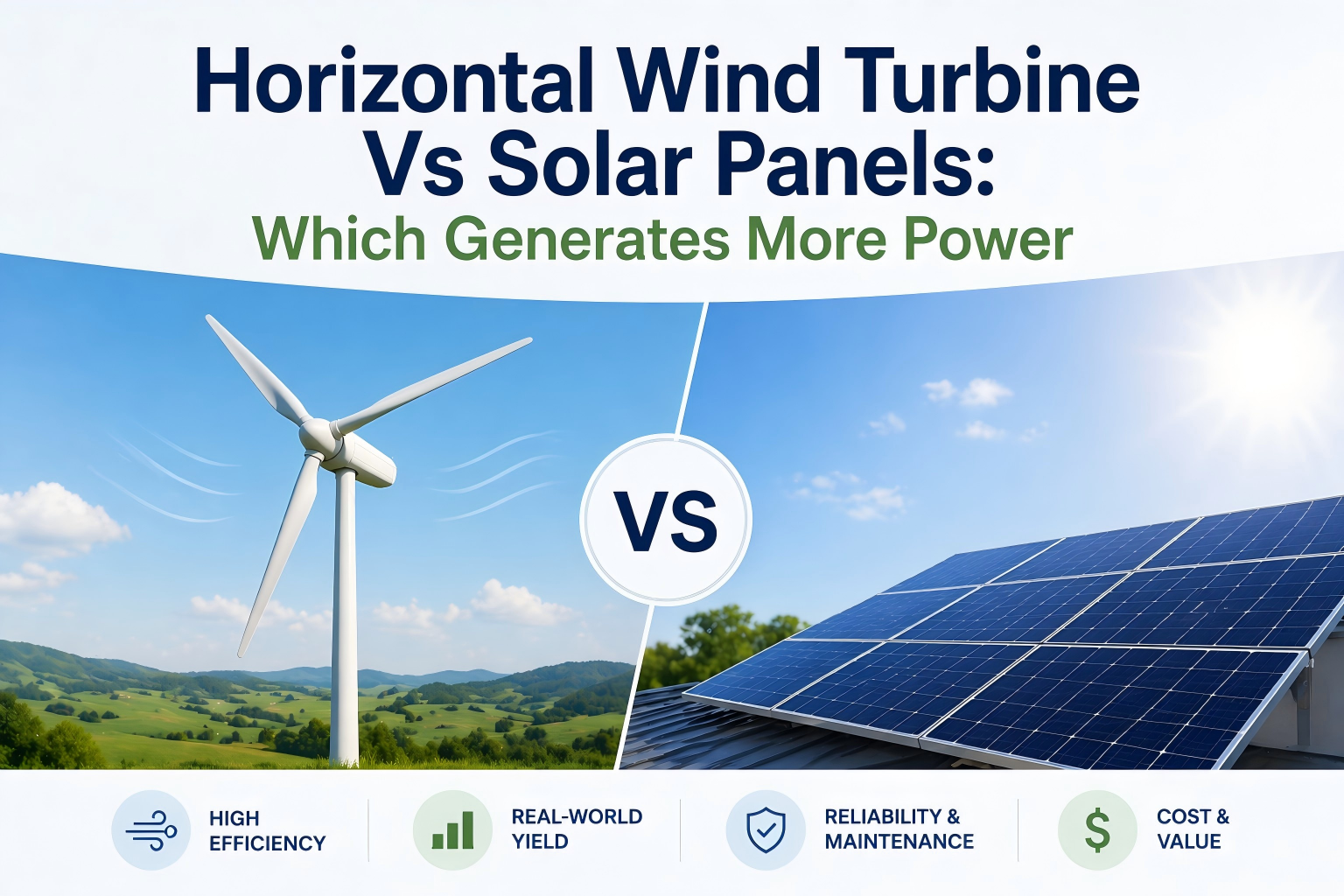
Buyers evaluating renewable energy often face a confusing dilemma. They struggle to separate theoretical energy efficiency from practical power yield. You want maximum electricity generation, but manufacturer brochures rarely tell the entire story.
While a wind generator boasts superior kinetic conversion rates, solar panels frequently deliver higher actual energy yields in sub-utility environments. People mistakenly assume raw system capacity guarantees household electricity. The reality heavily depends on your localized geography. Generating consistent power requires matching the right technology to the right environment.
This guide compares both systems based on raw output capabilities, conversion efficiency, mechanical reliability, and site-specific installation realities. We will determine which setup delivers more usable power per dollar invested. Read on to uncover the physics and practical constraints behind these popular renewables.
Utility vs. Residential: On a utility scale, wind dominates (producing roughly 80% more total national grid power in recent U.S. EIA data). In residential/commercial applications, solar consistently yields more reliable power.
Efficiency Gap: A horizontal axis wind turbine can convert up to 45–60% of kinetic energy into electricity, whereas high-end solar panels peak at 20–23% photoelectric conversion.
The Usability Threshold: Wind turbines require sustained average wind speeds of 12+ mph and elevated clear air space (usually 80+ feet), severely limiting their practical output in urban or suburban zones.
Maintenance & Uptime: Solar's lack of moving parts translates to higher long-term uptime, directly impacting net lifetime power generation.
Power conversion metrics dictate how much ambient energy a system can successfully capture. Wind energy leverages the kinetic mass of moving air. Physics limits this capture rate through a principle known as the Betz limit. According to this law, no turbine can capture more than 59.3% of the kinetic energy in the wind. However, a well-engineered horizontal wind turbine consistently achieves 45–60% efficiency. This approaches the theoretical maximum.
Solar panels operate under different physics. They rely on the photovoltaic effect. Photons strike silicon cells to knock electrons loose. This process suffers from the Shockley-Queisser limit. High-end commercial solar panels peak around 20–23% efficiency. Much of the sun's energy spectrum simply passes through the panel or turns into waste heat. On a purely scientific level, wind converts raw input into electricity twice as efficiently as solar.
Density matters when evaluating power generation at scale. Utility wind power offers a massive density advantage. You can clearly see this in industrial applications. A single megawatt-class horizontal turbine generates immense electricity. It easily produces the equivalent power of several acres of solar arrays. Industry benchmarks often equate one utility turbine to roughly seven football fields of dense solar panels. Wind farms also allow simultaneous land use. Farmers routinely grow crops directly beneath the spinning blades.
We must also look at life-cycle emissions. Clean energy requires manufacturing, and manufacturing emits carbon. Wind energy produces a exceptionally low carbon footprint per kilowatt-hour generated. The average footprint sits around 4.64g CO₂/kWh. You only need to manufacture the tower, nacelle, and blades. Solar panels require energy-intensive silicon smelting. Their manufacturing footprint hovers around 70g CO₂/kWh. Over decades of operation, wind turbines run significantly "greener" from an emissions standpoint.
Metric | Horizontal Wind Turbines | Commercial Solar Panels |
|---|---|---|
Energy Conversion Rate | 45% – 60% | 20% – 23% |
Theoretical Limit | 59.3% (Betz Limit) | ~33% (Shockley-Queisser) |
Space-to-Power Ratio | Very High (Vertical footprint) | Low (Requires vast acreage) |
Carbon Footprint | ~4.64g CO₂/kWh | ~70g CO₂/kWh |
Maximum wattage ratings deceive many first-time buyers. A 5kW system rating only tells you what the equipment produces under perfect conditions. Solar generation proves highly predictable. Planners easily calculate yields based on historical geographic sun hours. You know exactly when the sun rises and sets.
Wind generation behaves chaotically. It remains subject to extreme near-ground turbulence and sudden seasonal variability. A system might spin furiously during a winter storm but sit completely idle for three weeks in summer. This unpredictability creates a massive gap between nameplate capacity and actual daily yield.
Every system has a floor. A horizontal axis wind turbine suffers steep power drops if wind falls below its cut-in speed. This threshold typically sits between 7 and 9 mph. If the wind blows at 5 mph, the turbine generates absolutely zero electricity. The blades might spin slowly, but they lack the torque to excite the alternator.
Conversely, solar panels still produce fractional power under heavy cloud cover. Modern systems utilize Maximum Power Point Tracking (MPPT) charge controllers. These devices aggressively optimize voltage. Even during a rainy afternoon, solar arrays consistently trickle-charge battery banks. They rarely hit an absolute zero-output state during daylight hours.
Utility benchmark tests highlight this reality clearly. Standard 14-month residential evaluations consistently show surprising results. Home solar installations routinely produce up to five times more total kilowatt-hours than identically rated residential wind turbines. The wind turbines simply spend too many hours sitting below their cut-in speeds. The steady, predictable nature of daily sunlight easily overtakes intermittent wind gusts over a calendar year.
Smooth, non-turbulent air drives wind power. Ground clutter ruins this airflow. Trees, neighboring houses, and slight hills create chaotic wind patterns called turbulence. To escape this "dirty air," you must mount installations onto 80-foot or taller towers. This altitude requirement triggers strict local zoning regulations. Many suburban municipalities enforce strict height limits. These restrictions routinely kill residential wind project feasibility before construction even begins.
Consider these common installation barriers:
Airspace Restrictions: Proximity to airports or protected flight paths blocks tall tower construction.
HOA Guidelines: Homeowner associations universally reject 80-foot steel towers in residential neighborhoods.
Setback Requirements: Zoning laws require towers to sit a specific distance from property lines. If a tower falls, it must remain entirely on your land.
Mechanical realities present severe challenges. Wind turbines act as giant levers in the sky. Mounting them on roofs or mobile platforms like RVs causes immediate structural damage. The spinning blades create intense vibration. The wind pushes against the tower, transferring massive torque into your roof joists. This creates intolerable noise inside the structure and compromises structural integrity. Solar panels distribute their weight evenly across the surface. They sit flush against the roof and require minimal structural reinforcement.
Robust wind generation requires heavy civil engineering. You cannot simply bolt a tower to the ground. Installers must dig deep trenches and pour steel-reinforced concrete foundations. These footings withstand massive lateral wind loads during severe storms. Ground or roof-mounted solar relies on simple aluminum racking systems. Workers install solar racks quickly using standard lag bolts and flashing.
Average deployment costs heavily favor solar energy for everyday consumers. Residential or commercial solar averages around $3.18 per watt. A standard home setup generally costs between $11,000 and $15,000 before tax incentives. This includes the panels, inverters, racking, and professional installation.
Equivalent horizontal wind systems demand vastly higher initial capital. A reliable residential wind setup can cost anywhere from $15,000 to well over $75,000. You pay heavily for tower fabrication, concrete foundation engineering, crane rentals, and specialized labor. You must spend drastically more upfront just to access the required wind speeds.
Mechanical wear dictates system uptime. Wind turbines operate under extreme stress. They house gearboxes, bearings, slip rings, and yaw mechanisms. These moving parts require routine lubrication. Bearings eventually fail and require replacement. Every hour spent lowering the tower for maintenance equals zero power generation.
Solar's static nature ensures near-100% mechanical uptime. Panels just sit there. They have no moving parts to grind, break, or lubricate. Your only maintenance involves occasional surface cleaning to remove dust or snow. This static reliability ensures maximum power harvesting over the long term.
Feature | Residential Solar System (5kW) | Residential Wind System (5kW) |
|---|---|---|
Average Capex Range | $11,000 – $15,000 | $15,000 – $75,000+ |
Primary Cost Drivers | Panels, Inverter, Standard Racking | Tower Steel, Concrete Footings, Crane Rental |
Moving Parts | None (Static system) | Blades, Bearings, Gearbox, Yaw Motor |
Maintenance Downtime | Negligible (Occasional washing) | Moderate to High (Requires mechanical servicing) |
Wind remains an incredible resource under the right conditions. You should choose horizontal wind generation if your site matches specific criteria. It excels for utility-scale investments and massive agricultural plains. Coastal properties also benefit greatly from relentless sea breezes. You need verified, uninterrupted average wind speeds exceeding 12 mph. You also need expansive acreage to satisfy zoning setbacks and avoid ground-level turbulence.
Solar represents the definitive choice for almost everyone else. You should install solar panels on residential properties and suburban commercial buildings. They dominate mobile and off-grid setups for RVs and vans. Choose solar if zoning laws restrict tower heights. Choose solar if trees surround your property. The minimal maintenance and predictable daytime yield make it the most logical investment for localized power generation.
You do not always have to choose just one. The ultimate reliability solution involves pairing both technologies. You combine them using a Battery Energy Storage System (BESS). This hybrid approach captures daytime solar energy when the sun shines brightest. It captures nighttime or storm-driven wind energy when solar panels sit dormant. By feeding both sources into a smart BESS, you ensure 24/7 grid independence and smooth out the inherent unpredictability of renewable weather patterns.
Evaluate Potential vs. Access: If your metric is potential power at scale in open areas, horizontal wind turbines win. If your metric is accessible, consistent power for a localized property, solar panels are vastly superior.
Verify Local Conditions First: Never rely purely on manufacturer spec sheets. Conduct a localized anemometer test for wind speeds over several months. Perform a thorough shading analysis for solar potential.
Respect Structural Limits: Avoid mounting wind generators to residential roofs or vehicles to prevent severe torque damage.
Prioritize Uptime: Factor maintenance downtime into your expectations. Solar's lack of moving parts provides inherently higher mechanical reliability.
Making a substantial capital investment requires brutal honesty about your physical location. By assessing your real-world wind speeds, zoning laws, and budget, you can deploy the technology that genuinely delivers the most power.
A: Yes. This provides a distinct advantage over solar arrays during continuous wind events. However, nighttime power generation remains heavily dependent on your local nocturnal wind patterns. If the air stills after sunset, generation drops to zero.
A: A typical 5kW home wind turbine generates roughly the same daily yield as a 24-panel high-efficiency solar array. This benchmark assumes optimal weather conditions and correct installation environments for both respective systems.
A: We strongly advise against this. Roof-mounted turbines cause severe mechanical vibration and structural torque damage to the building. Furthermore, you will experience extreme power loss due to high turbulence at roof level.
A: Wind turbines require significantly more maintenance. They rely on active mechanical parts like bearings and gearboxes that need routine lubrication. Solar panels are entirely static and generally only require occasional surface cleaning and basic inverter checks.