Views: 0 Author: Site Editor Publish Time: 2026-07-20 Origin: Site

Evaluating wind energy for residential or commercial sites usually hits one major roadblock: noise. Property owners want renewable power but fear a spinning rotor will sound like a jet engine, triggering neighbor complaints and zoning violations. Marketing brochures often promise virtually silent operation. However, physical realities like rotating machinery, aerodynamic friction, and strict local noise ordinances tell a different story. To successfully deploy a vertical axis wind turbine, you must look past generalized decibel ratings. You need to understand the specific aerodynamic, mechanical, and environmental factors that dictate how a turbine actually sounds in a real-world environment. Relying on lab data alone leads to failed inspections and angry neighbors. We will break down exactly what generates noise, how to mitigate structural vibration, and where to place your equipment to ensure full compliance.
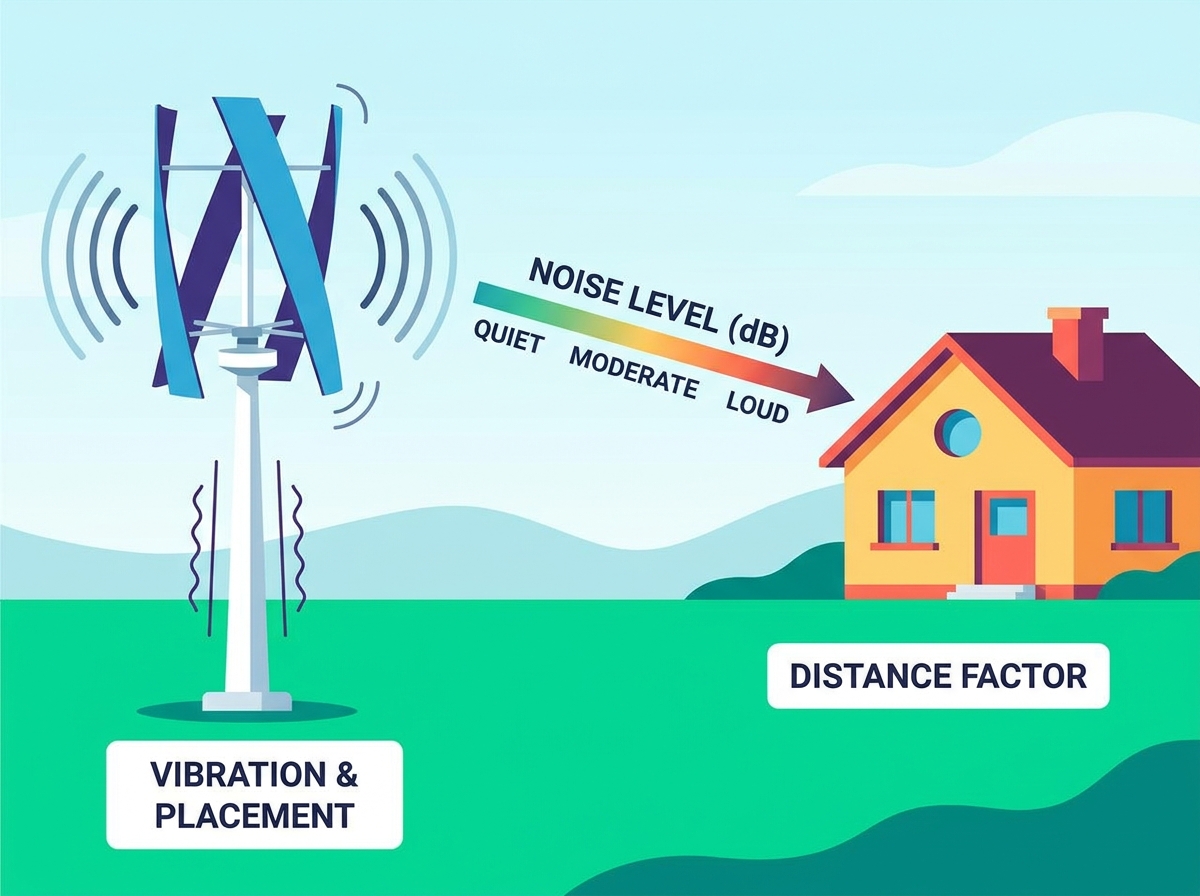
Realistic Decibel Ranges: Most modern VAWTs operate between 35 dB and 50 dB at a standard setback distance, comparable to a quiet library or the low hum of a refrigerator.
Primary Noise Sources: Sound generation is split between aerodynamic noise (vortex shedding, blade turbulence) and mechanical noise (generator hum, bearing friction).
Vibration Management is Critical: For roof-mounted installations, structural vibration transmission is often a larger nuisance than airborne noise, requiring specialized isolation mounts or magnetic levitation (maglev) technology.
The Testing Gap: Laboratory acoustic ratings are often conducted in low-turbulence environments, which can underestimate real-world operational noise when the turbine is subjected to turbulent urban wind flows.
Placement Dictates Compliance: Strategic siting, accounting for distance decay, atmospheric conditions, and ambient baseline noise, is mandatory for passing local zoning regulations and avoiding nuisance claims.
Before breaking ground on any installation, you must define what constitutes acceptable noise for your specific zoning district. Residential zones enforce strict nighttime noise limits, often capping allowable sound at 45 dB at the property line. Commercial and industrial zones offer more leeway, sometimes allowing up to 60 dB. Failing to establish these baseline success criteria before purchasing equipment guarantees permitting headaches.
Decibels (dB) measure sound intensity on a logarithmic scale. A 10 dB increase means the sound is ten times more intense and perceived as twice as loud. To evaluate equipment specifications, you need a practical frame of reference.
Sound Source | Approximate Decibel Level (dB) | Perceived Loudness |
|---|---|---|
Rustling leaves, quiet whisper | 20 - 30 dB | Barely audible |
Quiet rural night, library | 35 - 40 dB | Faint background noise |
Modern VAWT at 30 meters | 40 - 45 dB | Low hum, easily masked by wind |
Moderate rainfall, refrigerator | 50 - 55 dB | Noticeable but not disruptive |
Normal conversation at 1 meter | 60 - 65 dB | Intrusive if sustained outdoors |
Manufacturers measure decibels differently. Some record sound directly at the source, while others measure from a 10-meter or 30-meter setback. You must standardize these metrics. Always ask for the sound power level (LwA) rather than just the sound pressure level, as LwA provides a true measure of the acoustic energy emitted regardless of distance.
Wind interacting with moving blades generates aerodynamic noise. This sound stems from vortex shedding and blade turbulence. As the blade slices through the air, it creates a wake of swirling vortices. When these vortices detach from the trailing edge of the blade, they produce a distinct whooshing sound. The intensity of this sound depends heavily on the inflow turbulence.
Laboratory wind-tunnel testing usually happens in highly controlled environments. These tunnels feature low inflow turbulence intensity, often around 0.15%. Real-world urban and suburban environments present a completely different aerodynamic reality. Buildings, trees, and varied topography disrupt airflow, creating highly turbulent, multi-directional wind streams. When this dirty wind hits the rotor, vortex shedding becomes erratic and significantly louder. Relying solely on lab data will leave you unprepared for the actual noise generated on site.
Internal hardware generates the second half of the acoustic profile. Alternators, gearboxes, and main bearings produce mechanical noise. A poorly machined bearing will grind, while a generator under heavy load will emit a low-frequency hum. Mechanical wear over time increases this baseline decibel output. If you neglect routine maintenance, a quiet machine will become a neighborhood nuisance within three years. Proper lubrication, tensioning, and timely part replacement keep mechanical noise in check.
The fundamental geometry of a turbine dictates its acoustic signature. Horizontal and vertical models interact with wind differently, resulting in distinct noise profiles that impact where you can legally and practically install them.
Vertical axis models operate at a lower Tip Speed Ratio (TSR) than horizontal models. TSR is the ratio of the speed of the blade tip to the actual wind speed. Horizontal blades rely on high rotational speeds to generate lift, often spinning their tips at five or six times the speed of the wind. This high velocity shears the air aggressively, creating loud, high-frequency aerodynamic noise.
Vertical models rotate much slower. Their TSR rarely exceeds 2.5. This lower blade velocity translates directly to reduced aerodynamic friction. The blades push through the air rather than slicing it at extreme speeds, resulting in a lower, less intrusive acoustic output. This mechanical reality makes vertical designs inherently better suited for populated areas.
Utility-scale horizontal turbines produce 35 to 45 dB, but they achieve this rating at a massive distance of 300 meters or more. They rely on vast open spaces to dissipate sound. Distributed-scale vertical turbines face a much tougher challenge. They must achieve similar or lower decibel levels while sitting just 10 to 50 meters from occupied structures. Engineers must design these smaller units with extreme precision to manage noise at such close range.
Infrasound consists of sound waves below 20 Hz. Humans cannot hear these frequencies, but we can feel them as pressure or vibration. Large horizontal turbines generate significant infrasound as their massive blades pass the support tower, creating a rhythmic pressure pulse. This low-frequency thumping penetrates walls and windows easily, leading to sleep disruption and complaints.
Vertical models generate significantly less infrasound. Their continuous rotational geometry and smaller scale do not produce the same massive pressure pulses. Field measurements consistently show that distributed-scale vertical units do not emit problematic levels of low-frequency noise, making them much safer for residential deployment.
You cannot eliminate wind noise entirely, but you can mitigate it through smart hardware selection. When shortlisting equipment, you must evaluate the specific engineering solutions manufacturers use to dampen sound and vibration.
Traditional mechanical bearings rely on steel balls rolling inside a metal race. Even with perfect lubrication, this creates friction, heat, and noise. Maglev technology replaces these physical bearings with magnetic suspension. The entire rotor assembly floats on a magnetic field, eliminating metal-on-metal contact.
This frictionless rotation drastically reduces mechanical noise. It also stops vibration at the source before it can travel down the mounting pole. Beyond acoustic benefits, maglev systems require zero lubrication and suffer almost no mechanical wear, extending the maintenance lifecycle of the unit by years.
Blade shape dictates aerodynamic noise. Straight-bladed Darrieus models experience a phenomenon called torque ripple. As the straight blade moves through its rotation, its angle of attack relative to the wind changes abruptly. This causes a pulsing, rhythmic whoosh that many find annoying.
Helical blades solve this problem. By twisting the blade along its vertical axis, engineers ensure that some portion of the blade is always engaged with the wind at an optimal angle. This continuous aerodynamic pressure smooths out vortex shedding. The result is a steady, white-noise hum rather than a rhythmic pulse. Drag-based Savonius designs also operate quietly due to their low rotational speeds, though they sacrifice overall efficiency compared to helical lift-based models.
Airborne noise is only half the battle. Structural vibration transmission will ruin an installation faster than aerodynamic whooshing. If you bolt a metal turbine directly to a metal pole or a wooden roof truss, the entire structure acts as an amplifier.
Install heavy-duty elastomeric dampeners between the turbine base and the mounting flange.
Use thick rubber isolation pads under all structural brackets.
Implement acoustic decoupling sleeves around all mounting bolts to prevent metal-to-metal vibration transfer.
Fill hollow steel mounting poles with sand or specialized acoustic foam to deaden resonance.
Hardware engineering means nothing if you place the unit poorly. Strategic siting dictates your compliance with local regulations and determines whether your neighbors will tolerate the installation.
Never judge a site's acoustic profile based on a single visit. Wind speeds, atmospheric conditions, and background noise fluctuate constantly. A site that seems perfectly quiet on a Tuesday afternoon might experience heavy traffic noise on a Friday morning. You must conduct multiple observations across different days, times, and weather conditions to establish a true baseline.
Weather changes how sound travels. Wind direction obviously carries sound downwind, but wind shear also plays a role. Higher wind speeds at higher elevations can bend sound waves back down toward the ground, increasing noise levels at neighboring properties.
Temperature inversions at night trap cool air near the ground, which also refracts sound waves downward. A turbine that passes noise tests during the day might violate ordinances at night due to this atmospheric bending. Additionally, seasonal changes matter. Trees full of leaves provide excellent ambient noise masking in the summer. When those leaves fall in winter, the baseline ambient noise drops, making the turbine seem much louder.
Sound dissipates over distance according to the Inverse Square Law. In a free field, sound pressure drops by 6 dB every time you double the distance from the source. If a turbine produces 56 dB at 10 meters, it will produce roughly 50 dB at 20 meters, and 44 dB at 40 meters.
You must calculate these setback distances accurately. Measure the distance from your proposed installation site to the nearest property line. Use the manufacturer's LwA data to calculate the expected decibel level at that exact boundary. If the calculated number exceeds the local zoning limit, you must move the installation site further inward.
Roof-mounting looks convenient, but it carries severe acoustic risks. Residential and commercial roofs are essentially large hollow drums. When you mount a rotating mass to a roof truss, the building envelope amplifies every low-frequency vibration. This resonance travels down the walls, creating a constant, maddening hum inside the structure.
Ground-mounting is the superior choice for acoustic isolation. Pouring an independent, steel-reinforced concrete pad decouples the turbine from any occupied structure. The massive weight of the concrete absorbs mechanical vibration, preventing it from traveling through the soil. Always prioritize ground mounts unless you have hired a structural engineer to design a custom, acoustically decoupled roof truss system.
Zoning boards do not care about manufacturer brochures; they care about hard data. Before applying for a permit, you must measure your site's ambient baseline noise. Rent a calibrated decibel meter and record the L90 metric, which represents the background noise level exceeded 90% of the time.
Read your municipal code carefully. Many jurisdictions do not enforce a hard decibel limit; instead, they restrict how much noise you can add above the existing ambient baseline. For example, the code might state that the turbine cannot increase ambient noise by more than 5 dB at the property line. Having documented baseline data proves to the zoning board that your installation will remain compliant.
The renewable energy market is flooded with cheap, poorly engineered equipment. You must vet vendor claims ruthlessly before committing capital. Look for hard engineering data, not marketing fluff.
Never accept a manufacturer's internal testing data at face value. Demand third-party acoustic certifications. Reputable manufacturers pay independent laboratories to test their equipment according to IEC 61400-11 standards. This standardized testing protocol ensures the data is accurate and comparable across different brands.
Scrutinize the testing conditions. Verify whether the acoustic tests occurred in a controlled, low-turbulence wind tunnel or under realistic turbulent inflow conditions. If the manufacturer cannot provide third-party data, cross them off your list immediately.
A quiet turbine on day one means nothing if the bearings fail on day four hundred. Evaluate the warranty terms specifically regarding mechanical components. A manufacturer offering a ten-year warranty on main bearings demonstrates confidence in their machining tolerances. Review the required service intervals. If the manual requires complex bearing lubrication every six months, you are looking at a high-maintenance machine that will likely become noisy as soon as you miss a service date. Choose equipment with sealed, maintenance-free bearings or maglev technology to ensure long-term acoustic stability.
A vertical axis wind turbine is not entirely silent, but when engineered correctly with a low tip speed ratio, helical blade design, and magnetic levitation technology, it operates well within acceptable residential and commercial noise thresholds. Success requires moving past marketing claims and focusing on hard acoustic data, structural isolation, and strategic site placement.
Rent a calibrated decibel meter to conduct a thorough ambient noise baseline study on your property across multiple days and weather conditions.
Pull your local zoning codes to determine the exact setback requirements and allowable decibel limits at your property lines.
Demand third-party certified IEC 61400-11 acoustic testing data from any manufacturer before finalizing a purchase.
Prioritize ground-mounted installations on isolated concrete pads to completely eliminate the risk of structural vibration transmission into occupied buildings.
A: Most modern models operate between 35 dB and 50 dB at a standard setback distance. This is comparable to the noise level of a quiet library or the low hum of a standard household refrigerator.
A: Yes, roof-mounted installations can transmit structural vibrations throughout the building envelope. This often causes resonance and low-frequency noise amplification, making ground-mounting a much safer option for acoustic isolation.
A: Vertical models generally operate at a lower Tip Speed Ratio (TSR), which reduces aerodynamic noise. They are designed to achieve lower decibel levels at closer proximity to occupied structures compared to utility-scale horizontal turbines.
A: Maglev technology replaces traditional ball bearings with magnetic suspension. This eliminates mechanical friction, which significantly reduces overall decibel output, dampens vibration, and improves the long-term maintenance lifespan of the turbine.
A: While utility-scale horizontal turbines can produce noticeable low-frequency acoustic signatures, distributed-scale vertical models generate significantly less infrasound. This reduces the risk of low-frequency noise complaints in residential areas.
A: Laboratory acoustic ratings are often conducted in low-turbulence wind tunnels. Real-world urban and suburban environments have highly turbulent, disrupted airflow, which increases vortex shedding noise and overall decibel output.