Views: 0 Author: Site Editor Publish Time: 2026-08-03 Origin: Site

Project developers know selecting turbine capacity solves only half the equation. Buyers frequently face a strict bottom-of-funnel dilemma. They have finalized their generation equipment. Now, they must navigate conflicting return-on-investment models regarding installation infrastructure. The core premise seems obvious at first glance. Taller structures capture faster, more reliable wind. However, the exponential increase in foundation engineering, material volume, and installation costs dictates a different reality. Sinking deep concrete foundations requires immense capital. Ground-level realities often challenge aerodynamic theories.
This article provides a rigid, evidence-based evaluation framework. We will help you analyze critical site parameters accurately. You will learn whether an 18m, 24m, or 30m structure yields the optimal balance. Our goal is to align your energy production targets, structural integrity limits, and capital efficiency. By evaluating site profiles objectively, you can secure long-term performance.
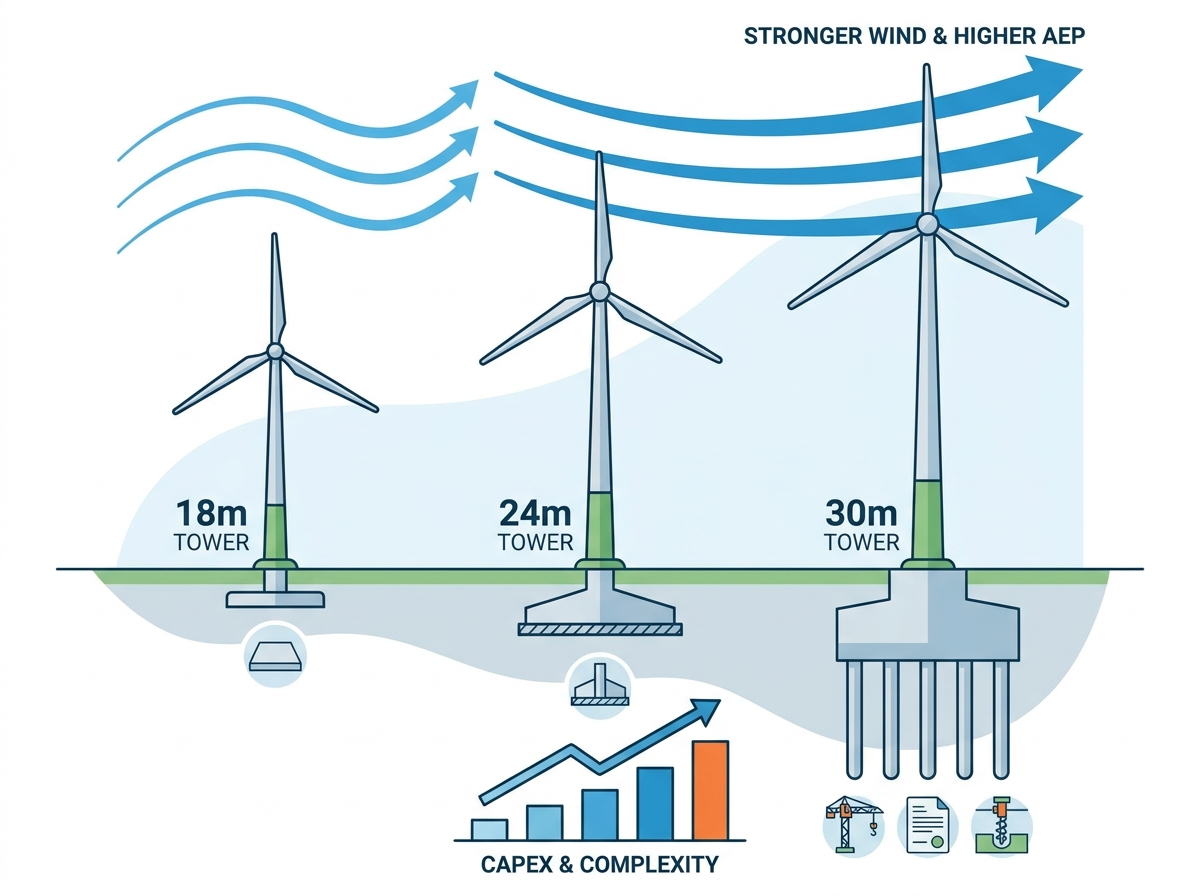
Wind shear and surface roughness dictate minimum height; placing a turbine too low permanently cripples Annual Energy Production (AEP).
The 18m tower minimizes zoning friction and crane costs, ideal for flat, unobstructed terrains.
The 24m tower serves as the industry baseline for sub-100kW systems, balancing foundation expenditure with clean air access.
The 30m tower maximizes yield but requires rigorous geotechnical surveys and substantially higher capital, making it best suited for higher-capacity systems (e.g., 200kW) or highly obstructed sites.
ROI must be calculated by measuring the marginal cost of steel and foundation upgrades against the marginal increase in AEP over a 20-year lifecycle.
Selecting your ideal wind turbine tower height requires understanding pure atmospheric physics. Altitude directly influences financial returns. You cannot rely on vendor assumptions. You must calculate site-specific mathematical realities.
Topography fundamentally changes wind speeds at different altitudes. Friction from the ground slows air movement. As you move higher, this friction decreases. This phenomenon is the wind shear exponent. A site characterized by tall trees or rolling hills has a high shear exponent. Here, wind speeds jump dramatically as you move from 18m to 30m. Conversely, smooth coastal plains have a low shear exponent. Altitude gains on flat terrain yield smaller marginal wind speed improvements.
Wind energy follows the cubic power law. Power available in the wind is proportional to the cube of the wind speed. This is a crucial concept. A mere 10% increase in wind speed yields roughly a 33% increase in available power. This exponential relationship highlights why elevation matters heavily during the decision stage. Capturing slightly faster air translates to massive generation gains.
Obstacles create turbulent airflows. Turbulence acts like rough water, causing mechanical fatigue. It stresses blades and leads to premature gearbox failure. Industry standards dictate a strict rule of thumb. The lowest tip of the rotor blade must clear any local obstacle by a minimum of 9 to 10 meters. Furthermore, you must apply this clearance rule to any obstacle within a 150-meter radius of the foundation. Placing rotors in turbulent boundary layers cripples efficiency.
Manufacturers standardize infrastructure into distinct tiers. Each tier balances materials, logistics, and aerodynamic access differently. Evaluating these options requires matching elevation to local geography.
The 18-meter model minimizes capital outlay. It is best suited for coastal sites, expansive agricultural plains, and bare terrain. These locations experience minimal ground drag. Developers also choose this tier to navigate strict visual impact laws. Local zoning ordinances frequently cap structural elevations. The 18-meter option safely avoids these regulatory height caps. However, drawbacks exist. This elevation is highly susceptible to ground-level turbulence. It also heavily limits maximum rotor diameter, restricting larger systems.
Moving up to 24 meters provides a balanced commercial solution. This tier works beautifully for lightly wooded areas and mixed agricultural environments. The primary advantage is clearance. A 24-meter elevation often clears the boundary layer of standard ground obstructions. It reaches clean air effortlessly. Crucially, contractors can usually install these units without requiring specialized heavy-lift cranes. This keeps logistical expenses manageable.
The 30-meter tier is the ultimate high-yield maximizer. It is essential for sites facing significant surface roughness. Heavy tree lines, nearby industrial structures, or low average wind speeds demand maximum altitude. Sometimes, this elevation is mandatory for commercial viability. The drawbacks center entirely on costs. Moving to 30 meters causes an exponential increase in foundation concrete. Soil bearing requirements become rigorous. Permitting complexity also spikes sharply, often requiring specialized aviation reviews.
Mismatched capacities and elevations destroy project economics. You must scale the infrastructure directly to the mechanical demands of the nacelle.
Sizing infrastructure for mid-scale power requires financial discipline. When planning a 50kw wind turbine tower, consider rotor diameter constraints first. These mid-sized units feature smaller swept areas. They can often achieve target RPMs easily at 18m or 24m elevations. Proportional cost is your main constraint here. Over-investing in a 30m structure for a 50kW unit creates a financial imbalance. The extra steel and concrete costs easily outpace the generation gains. This scenario destroys the expected payback period. Stick to 24 meters unless severe obstacles dictate otherwise.
Heavy-duty generation changes the structural math completely. When specifying a 200kw wind turbine tower, clearance requirements dominate the decision. Larger blades demand significantly higher hub elevations. You must maintain safe ground clearance during extreme deflection events. Structural load also dictates elevation choices. A 200kW nacelle and massive rotor generate massive overturning moments. Wind pushes against the broad swept area, creating immense leverage against the base. This dynamic requires robust lattice frameworks or extremely heavy monopole structures. These loads make 24m or 30m heights non-negotiable for safe operation.
Engineering feasibility only matters if the project makes financial sense. You must evaluate capital expenditures against marginal generation gains.
Tower material costs grow somewhat linearly. Adding steel sections costs a predictable amount. However, foundation and logistics costs grow exponentially. A 30m structure requires a vastly wider and deeper concrete footer than a 24m unit. Furthermore, lifting heavy nacelles to 30 meters requires specialized crane mobilization. Crane fees scale aggressively based on boom reach and lift capacity. You must model these logistics costs upfront.
Elevation Tier | Material Cost Growth | Foundation Volume Scale | Heavy Crane Required |
|---|---|---|---|
18m | Baseline (1.0x) | Baseline (1.0x) | No (Standard equipment suffices) |
24m | Moderate (1.3x) | High (1.6x) | Site Dependent |
30m | Significant (1.7x) | Exponential (2.5x+) | Yes (Specialized mobilization) |
Marginal Annual Energy Production (AEP) dictates your return. Do not look at total generation. Look at the specific kilowatt-hour gain. Calculate the exact gain of moving from 18m to 24m. Then calculate the gain from 24m to 30m. You must use local anemometer data for this. Apply the cubic power law to your site's specific wind shear profile. This reveals the actual revenue potential of the extra steel.
Define realistic return expectations early. Calculate the marginal cost of the structural upgrades. Compare this against the revenue from the marginal AEP. We advise a strict cutoff. Reject the taller option if the extra AEP takes more than 7 to 10 years to pay off the structural and foundation upgrades. Capital efficiency must govern the final procurement decision.
Theoretical math frequently collides with site-specific regulations. Ground conditions and local zoning boards always have the final say.
Local ordinance height limits dictate project timelines. Many jurisdictions enforce strict 100-foot (30.5m) thresholds. Staying just under this limit is a common strategy. Exceeding it triggers complex aviation lighting regulations. It also demands special use permits. Going through specialized zoning hearings delays projects by months. Always check municipal codes before specifying a 30m unit.
Soil bearing capacity dictates foundation design. A 30m structure generates extreme leverage. It requires vastly different soil compaction and foundational footprints compared to an 18m unit. Soft soils might require deep pilings for a 30m system. The same soil might easily support a simple spread footer for an 18m unit. Never assume foundation costs are proportional.
Consider long-term serviceability. Tilt-up designs are highly viable for 18m and 24m installations. Technicians can lower the entire system to ground level for safe servicing. This eliminates climbing risks. However, moving to a 30m elevation usually requires a fixed structure. Fixed designs demand active climbing protocols or crane rentals for component replacements. This increases long-term operational expenses.
Decision fatigue is common during procurement. Use these strict shortlisting rules to narrow your options immediately.
Select 18m if: Local permitting is rigidly capped, terrain is completely flat and bare, and your budget heavily prioritizes low upfront capital expenditures.
Select 24m if: You seek standard commercial returns, face moderate ground friction from low trees, and are installing capacities between 50kW and 100kW.
Select 30m if: You are deploying larger units, fighting heavy local turbulence, and possess sufficient capital for advanced foundation engineering.
Following this logic prevents costly over-engineering.
Define your turbine capacity and rotor diameter.
Map all local obstacles within a 150-meter radius.
Check municipal zoning laws for aviation caps.
Recommend conducting a 12-month LIDAR or anemometer study at the exact proposed hub heights before finalizing procurement.
Choosing the correct elevation is an exercise in marginal economics, not just aerodynamic optimization. Pushing a rotor higher always yields more raw power. However, generating power is distinct from generating profits. You must calculate the exact cost of foundation concrete and crane mobilization. Only then can you measure it against the marginal energy gains.
Always align the elevation closely with your specific turbine capacity. Mid-sized equipment rarely justifies extreme structural investments. Furthermore, map your site turbulence profile accurately to avoid mechanical fatigue. Lastly, research strict local zoning laws early to prevent permitting roadblocks. Taking these measured steps ensures your project achieves true commercial viability.
A: No. Retrofitting extra height is a structural and foundational impossibility. The concrete foundation size, rebar density, and base flange are engineered specifically for the overturning moments of the original height. Adding height post-installation risks catastrophic structural failure.
A: A 30m unit requires exponentially more concrete. Taller structures generate massive overturning moments due to increased wind leverage. To prevent tipping, engineers mandate exponentially wider and deeper bases. Expect concrete volume to double or even triple compared to an 18m base.
A: Generally, no. Standard FAA and international aviation guidelines trigger lighting requirements at the 200-foot (approx. 61 meters) mark. A 30-meter structure falls well below this threshold. However, strict local variances often apply for structures located near regional airfields or helicopter flight paths.
A: Monopoles offer lower visual impact and a smaller ground footprint, making them ideal for restricted sites. Lattice designs are visually intrusive and require wider bases. However, lattice options are significantly cheaper to transport and assemble. Monopoles generally offer superior climbing safety via internal ladders.