Views: 0 Author: Site Editor Publish Time: 2026-07-31 Origin: Site

The small wind market has historically experienced significant volatility. Vertical axis wind turbine (VAWT) technology offers distinct advantages, including omnidirectional wind capture, lower noise profiles, and ground-level maintenance access. However, the industry has been plagued by exaggerated marketing claims and underperforming products. Navigating this landscape requires a discerning eye to separate genuine engineering from sales rhetoric.
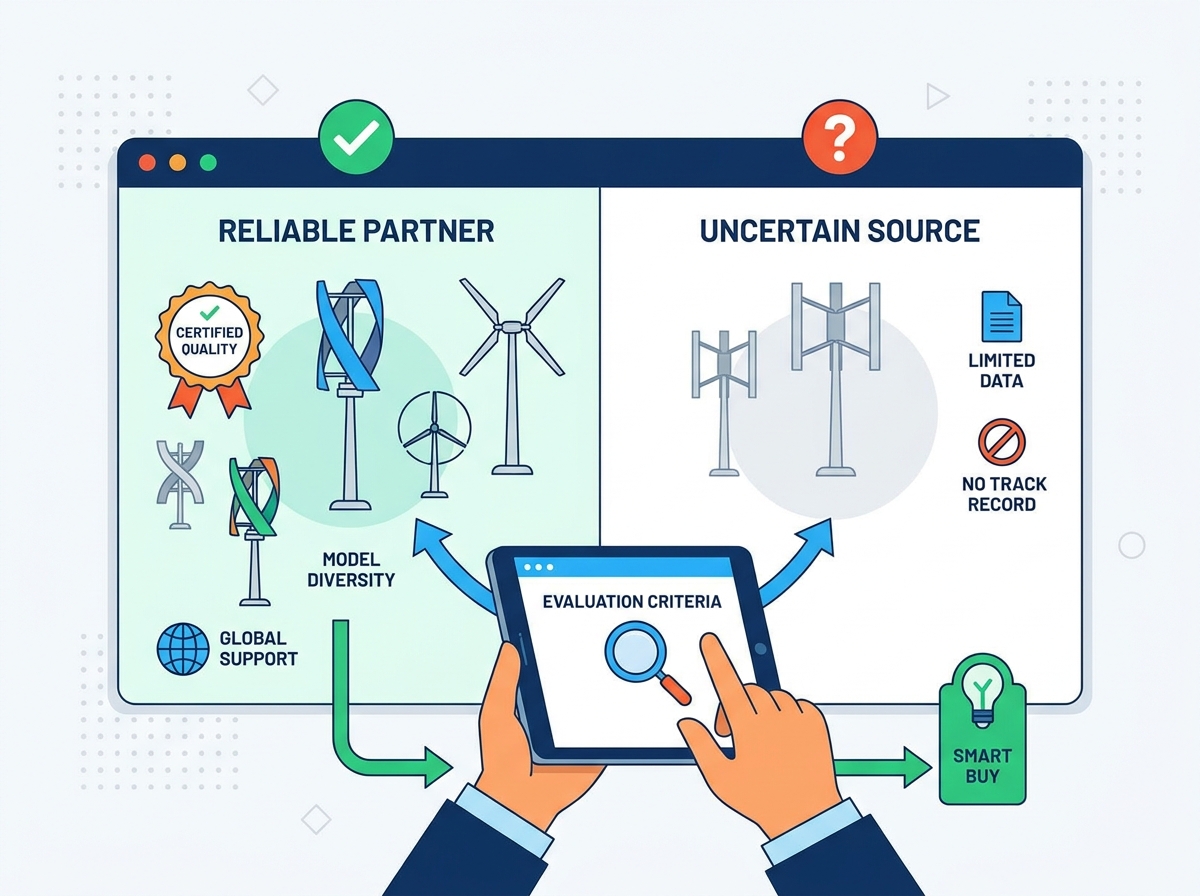
Selecting an unverified vendor carries substantial financial and operational risks. A poor procurement decision leads to stranded assets, high maintenance overhead, and a failure to achieve projected energy independence. When evaluating a vertical axis wind turbine manufacturer, buyers must prioritize rigorous, engineering-first assessments over superficial promises.
Mitigating these risks demands a systematic methodology for vetting vendors based on empirical data, structural integrity, and long-term viability. This guide provides an actionable framework to evaluate manufacturers, ensuring your investment yields predictable performance and structural survivability in real-world conditions.
Demand Independent Verification: Never rely on manufacturer-supplied power curves; require third-party testing data (e.g., IEC or AWEA/SWCC certifications) to validate performance claims.
Scrutinize the Swept Area: Understand that energy capture is governed by physics. Evaluate manufacturers based on realistic swept area metrics rather than inflated efficiency promises.
Prioritize Innovation & Lifecycle R&D: Choose manufacturers that invest in active R&D, patent protection, and modern material science to ensure your system does not become legacy technology without spare parts.
Assess Long-Term Viability: Focus on manufacturers with transparent supply chains, verifiable commercial track records, and comprehensive warranties that cover both parts and labor.
Match Model to Site Reality: Siting dictates success. A reputable manufacturer will require a rigorous wind resource assessment to optimize operational reliability before recommending specific available vertical axis wind turbine models.
A successful VAWT deployment hinges on predictable energy yield, structural survivability in extreme weather, and a low levelized cost of energy. Achieving these criteria requires looking past marketing jargon and focusing on aerodynamic realities. Field engineers know that wind energy extraction is bound by strict physical laws. You cannot cheat physics with a flashy brochure.
The physical limits of wind energy extraction are governed by the Betz Limit. This principle states that no turbine can capture more than 59.3% of the kinetic energy in wind. When evaluating claims, watch for red flags such as promises of efficiency exceeding these aerodynamic realities. Claims of high power generation at impossibly low wind speeds indicate a vendor disconnected from engineering facts. A credible manufacturer relies on physics and provides data backed by rigorous testing.
Understanding the difference between Savonius and Darrieus designs is fundamental. Savonius turbines are drag-based. They offer excellent self-starting capabilities and high torque at low speeds. This makes them suitable for highly turbulent urban environments where wind direction shifts rapidly. Darrieus turbines are lift-based. They provide higher efficiency at greater wind speeds but often require a starter mechanism. A reputable manufacturer will match these designs to specific site conditions, whether it involves suburban turbulence or open terrain, rather than pushing a one-size-fits-all solution.
Design Type | Aerodynamic Principle | Self-Starting | Optimal Environment | Efficiency Profile |
|---|---|---|---|---|
Savonius | Drag-based | Yes | Turbulent, urban, shifting winds | Lower peak efficiency, high torque |
Darrieus | Lift-based | No (typically requires assist) | Open terrain, consistent winds | Higher peak efficiency at speed |
H-Rotor (Giromill) | Lift-based (straight blade) | Variable | Commercial arrays, rooftops | Moderate to high efficiency |
Horizontal axis wind turbines (HAWTs) operate differently. They require yaw mechanisms to face the wind and place heavy generators at the top of a tall tower. VAWTs eliminate the yaw requirement and keep heavy components near the ground. This fundamental difference changes the maintenance profile entirely. Ground-level access means technicians do not need specialized climbing gear or cranes for routine generator inspections. However, the structural dynamics of VAWTs introduce different fatigue loads on the main shaft and bearings, which must be engineered correctly.
Energy capture is fundamentally limited by the swept area. This is the height multiplied by the diameter of the rotor. Swept area is the primary physical limit governing wind energy capture. You cannot generate 10kW of power from a rotor the size of a trash can, regardless of what a sales pitch claims. When evaluating a manufacturer's power curve, look for rated power at realistic wind speeds. Typically, this falls between 11 and 15 meters per second. Ignore peak output numbers that only occur in hurricane-force winds.
Verify the cut-in and cut-out wind speeds through independent testing data. Cut-in speed is when the turbine starts generating usable power. Cut-out speed is when the turbine applies brakes to prevent self-destruction. If a vendor claims a cut-in speed of 1 m/s and a rated output at 5 m/s, walk away. The energy available in the wind cubes with wind speed. There is simply not enough kinetic energy at 5 m/s to hit high rated outputs for small turbines.
Structural integrity relies heavily on material science. Evaluate the materials used for blades. Carbon fiber offers high strength-to-weight ratios but costs more. Aircraft-grade extruded aluminum provides excellent durability and resistance to high-frequency fatigue cycles. Fiberglass is common but must be inspected for delamination risks over time. The central shaft must withstand continuous alternating bending moments. Ask the vendor for their fatigue cycle testing data.
Assess tower design options carefully. Guyed towers require periodic tension checks using specialized tensiometers. If a guy wire goes slack, the entire structure can enter a destructive harmonic resonance. Self-supporting monopole towers offer a smaller footprint but require massive, heavily reinforced concrete foundations. The foundation engineering must account for overturning moments generated by the rotor drag.
Analyze the braking systems required to prevent catastrophic failure during extreme storm events. A robust turbine should incorporate multiple redundant braking mechanisms. Mechanical disc brakes provide positive stopping power but wear out. Aerodynamic braking, such as pitch control or spoiler deployment, sheds wind load. Electromagnetic braking shorts the generator phases to create massive resistance. A reliable system uses a combination of these to ensure safe shutdown under severe conditions.
Matching the right turbine to your operational requirements requires a clear decision matrix. Different scales of deployment demand specific evaluation criteria. You must align the hardware with the site realities and electrical infrastructure.
For residential and agricultural scale deployments, homeowners and ranchers have specific needs. Key evaluation criteria include ease of installation and compatibility with existing residential microgrids or battery storage. Zoning-friendly height profiles are critical to avoid permitting battles. Noise abatement and vibration isolation are mandatory for roof-mounted or close-proximity ground installations. A poorly isolated roof mount will turn the building structure into a giant acoustic amplifier.
Commercial and industrial scale deployments require a different approach. Small business owners and enterprise deployments focus on scalability. Array configuration capabilities are vital. Enterprise deployments can often exploit the aerodynamic spacing advantages of VAWTs. Unlike HAWTs, which require massive spacing to avoid wake turbulence, VAWTs can be placed closer together. In some configurations, closely spaced VAWTs actually enhance each other's performance through fluid dynamic coupling. Three-phase power integration and high-voltage grid-tied compatibility are standard requirements at this scale.
Evaluate whether the manufacturer offers custom configurations or relies on off-the-shelf products. Modular power electronics and tailored rotor heights allow systems to fit localized wind shear profiles. Rigid product catalogs may force a suboptimal fit for your specific site. You need to know if the vendor can supply available vertical axis wind turbine models that match your exact voltage and phase requirements without relying on third-party, unverified transformers.
Deployment Scale | Primary Focus | Electrical Integration | Mounting Preference |
|---|---|---|---|
Residential | Noise, Zoning, Aesthetics | Single-phase, Battery backup | Short monopole, isolated roof mount |
Agricultural | Durability, Off-grid capability | Direct drive water pumping, DC charging | Guyed lattice, open field |
Commercial | ROI, Array density, Grid offset | Three-phase, Grid-tied inverters | Heavy monopole, parapet mounts |
Evaluating a manufacturer requires a systematic approach to verify their engineering credibility and long-term viability. Do not skip these steps. Field failures are expensive and dangerous.
Detail the necessity of IEC 61400-2 safety and design standards for small wind turbines. This standard dictates structural safety factors and power performance measurements. Check for certifications from recognized national or international bodies. Look for the Small Wind Certification Council (SWCC), Intertek, UL for electrical components, and CE compliance. Independent verification is non-negotiable. If they only have in-house testing data, treat it as marketing material.
Investigate where critical sub-components like generators, inverters, and bearings are manufactured. Assess the risk of proprietary, non-standard parts. If the manufacturer experiences financial distress, you need to be able to source replacement bearings from standard industrial suppliers like SKF or Timken. Standardized components ensure long-term maintainability. Proprietary control boards are a massive risk factor.
Examine the manufacturer's R&D pipeline. Active patents for aerodynamic innovations, self-starting systems, or generator cooling indicate a forward-looking company. Verify if their models are actively engineered for modern grid integration and material advances. Static legacy designs from twenty years ago will not interface well with modern smart grids or lithium-ion battery management systems.
Analyze the difference between a standard parts warranty and a comprehensive performance guarantee. Identify common loopholes. Watch out for warranties voided by "extreme turbulence" or "abnormal weather events." Look for lack of coverage for inverter failure, which is the most common point of failure in any renewable energy system. Check for the exclusion of labor costs for high-altitude repairs or remote site travel.
Review the manufacturer's stipulated preventative maintenance schedule. Highlight mandatory field checks. These include checking and tightening structural bolts to specific torque values, inspecting blade connections for micro-fractures, and checking machines for galvanic corrosion. You must test electrical connections for resistance buildup and verify proper tension in guy wires. Evaluate the availability of local certified technicians versus reliance on factory dispatch. If you have to fly a technician in from across the country to grease a bearing, the operational costs will ruin your ROI.
Demand references for installations that have been operational for at least five years. Look for transparent reporting on downtime, maintenance costs, and actual versus projected energy yields from existing customers. A trustworthy manufacturer will readily provide verifiable operational histories. Call the references. Ask them about the vendor's response time when things break.
A top-tier manufacturer should guide you through site selection to optimize operational reliability. A credible vendor will insist on a rigorous wind resource assessment (WRA) before sale. This involves gathering hard data using anemometers mounted at the proposed hub height, LiDAR systems, or rigorous local wind modeling. Avoid vendors who sell based solely on low-resolution regional wind maps. Regional maps do not account for local obstacles, tree lines, or building wakes.
Strategic siting leverages design advantages. Optimize turbine placement near structures, ridgelines, or tree lines to capitalize on boundary layer turbulence without compromising structural life. Proper placement maximizes yield while minimizing fatigue loads. Placing a turbine directly behind a large building creates a wind shadow filled with chaotic, swirling air that will tear a turbine apart over time. You need clean, accelerated airflow.
Evaluate the manufacturer's support in navigating zoning, permitting, and environmental compliance. They should provide necessary engineering documents. You will need stamped structural drawings for the foundation, acoustic profiles to prove noise compliance at the property line, and wildlife impact reports required by local planning boards. If the vendor cannot provide a PE-stamped drawing for your specific soil type, you will fail the building inspection.
Electrical integration planning must happen during the site evaluation phase. Determine the cable run distance from the turbine to the inverter. Long DC cable runs require massive wire gauges to prevent voltage drop. The vendor should provide a detailed single-line electrical diagram showing disconnects, surge protection devices, and grounding rod requirements. Grounding is critical. A lightning strike on an improperly grounded turbine will destroy the inverter and potentially cause a fire.
Purchasing a VAWT is a long-term infrastructure investment, not a simple appliance purchase. Focus your shortlist on manufacturers offering certified power curves, transparent warranties, standard component sourcing, and a proven operational history. Do not let slick marketing override basic engineering principles.
Initiate a formal Request for Information (RFI) with 3 to 4 shortlisted vendors to compare technical specifications.
Request third-party testing data and demand a site-specific wind resource assessment based on local topography.
Verify the availability of local maintenance technicians and confirm that replacement parts use standard industrial sizing.
Review comprehensive warranty terms, paying close attention to labor exclusions and operational wind speed limits.
A: A well-maintained commercial unit lasts 15 to 20 years. This lifespan depends heavily on operating within designed fatigue limits, monitoring bearing wear, and strict adherence to routine maintenance schedules. Neglecting scheduled inspections drastically reduces operational life.
A: Request IEC or SWCC certified power curves. Compare these curves against the turbine's swept area to ensure the claims align with physical aerodynamic limits. Ignore peak power claims that only occur at unrealistic wind speeds.
A: VAWTs excel in turbulent, multi-directional wind and offer lower maintenance access heights. HAWTs generally provide higher overall efficiency in clean, laminar wind conditions. The best choice depends entirely on your specific site topography and wind profile.
A: Routine maintenance includes bolt torqueing, corrosion inspection, bearing lubrication, and electrical connection testing. You must also check guy wire tension if applicable and inspect blades for micro-fractures caused by continuous fatigue cycles.
A: Yes. You must match the turbine's variable frequency output to the correct power conditioning equipment. Grid-tied systems require specific inverters that can handle wild AC input and sync with utility grid frequencies safely.
A: Failures often stem from poor structural engineering, reliance on unverified aerodynamic claims, and lack of supply chain transparency. Insufficient R&D investment leaves them unable to adapt to modern grid requirements or resolve chronic mechanical fatigue issues.