Views: 0 Author: Site Editor Publish Time: 2026-05-29 Origin: Site
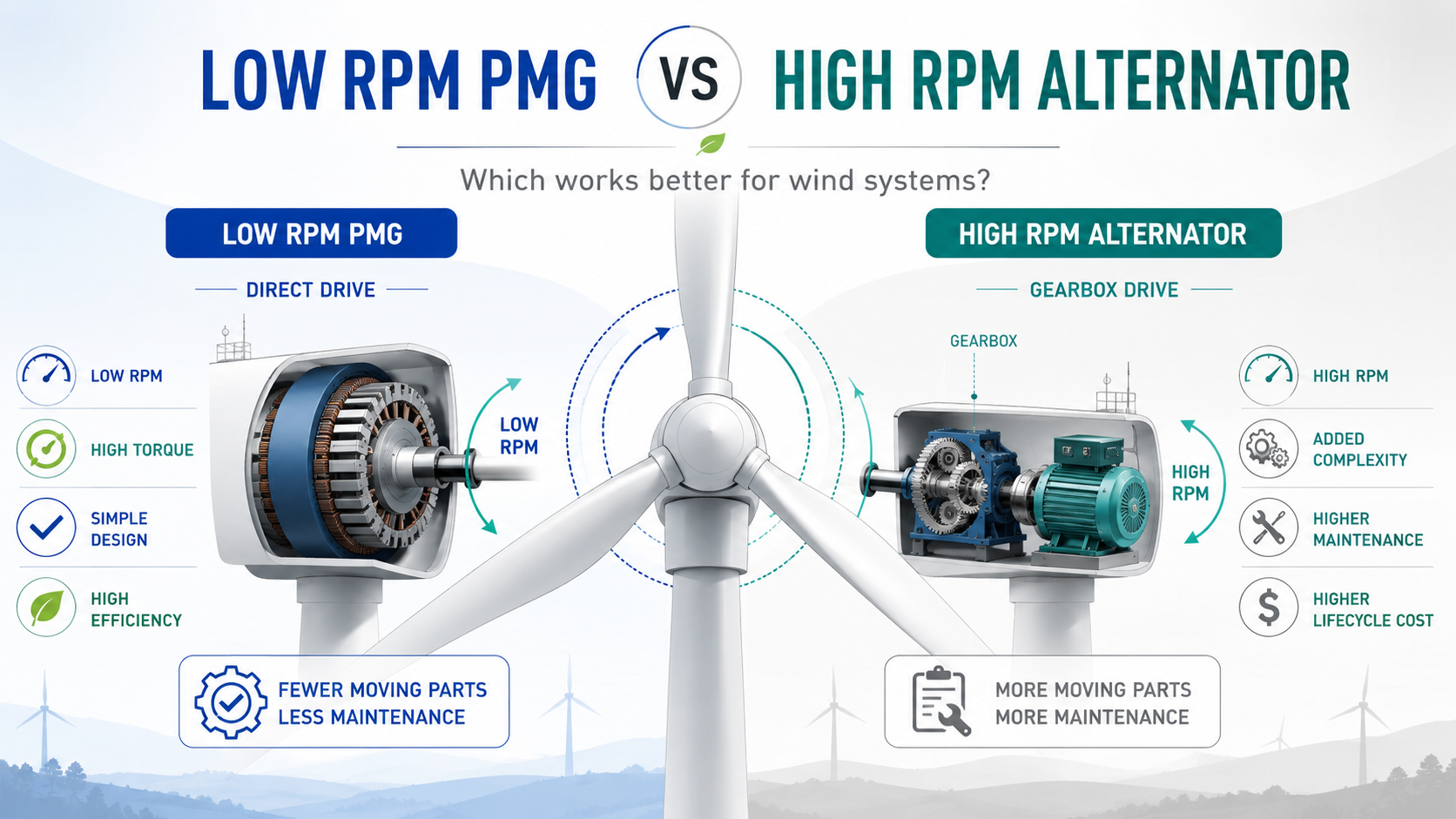
Harnessing wind power presents a fundamental mechanical mismatch. Wind turbine blades naturally capture the most energy at low rotational speeds. They generate massive physical torque. However, traditional power generation systems demand incredibly high RPMs to produce usable electricity. This engineering conflict forces system builders and commercial integrators to choose between two distinct pathways. You can either use a mechanical gearbox alongside an automotive-style alternator, or you can rely on a direct-drive permanent magnet generator. Both approaches have vocal advocates across the renewable energy sector. We need a skeptical, evidence-based look at how each option actually performs in the real world. Theoretical peak wattage often looks great on paper. Yet, practical application reveals a much different story. The best choice strictly depends on your average site wind profile and your tolerance for routine mechanical maintenance. We will explore the physics, benefits, drawbacks, and procurement realities of both technologies.
Excitation Penalty: Standard alternators require external power to create a magnetic field, resulting in parasitic draw and poor low-wind performance.
Direct Drive Advantage: A low RPM permanent magnet generator eliminates the need for mechanical gearboxes, drastically reducing maintenance and mechanical failure points.
Cogging Torque vs. Cut-in Speed: PMGs provide earlier voltage generation, but system matching (blade size to cogging torque) is critical to prevent turbine stalling.
Procurement Reality: Many consumer-grade generators feature inflated wattage claims; true output is dictated by physical stator mass and magnet grade (e.g., N42 vs. N52), not just marketing labels.
Wind capture physics present a clear paradox. Rotor diameter shares an inversely proportional relationship with rotational speed. Larger turbine blades sweep a wider area. They capture more wind energy and generate immense torque. However, they spin significantly slower than smaller blades. A robust residential wind turbine might max out at 200 to 400 RPM during a heavy gale. It will spend most of its operational life spinning far below those numbers.
Standard AC/DC generators fail entirely in direct-drive, low-speed applications. Traditional generators require massive rotational speeds to hit their target voltage output. Most commercial off-the-shelf generators need anywhere from 1,500 to 3,000 RPM to function properly. If you attach a standard generator directly to a wind turbine hub, it will barely register a trickle of voltage. The turbine simply cannot spin fast enough to cross the electrical threshold.
Engineers solve this rotor speed mismatch through two primary workarounds. You can choose a mechanical solution or an electromechanical solution.
Mechanical Scaling: You attach a step-up gearbox or a pulley system to a high RPM alternator. The turbine spins slowly, but the gears multiply the rotational speed before it reaches the generator shaft.
Electromechanical Adaptation: You eliminate the gears entirely. Instead, you deploy a low RPM permanent magnet generator. Manufacturers tailor these units specifically to produce high voltage at minimal rotational speeds.
Electromagnetic field (EMF) alternators dominate the automotive world. These units do not use permanent magnets. Instead, they pass an electrical current through a copper coil to create a temporary magnetic field. We call this process "excitation." The alternator requires an initial electrical input to wake up. Once the rotor spins fast enough, it generates more power than it consumes.
Builders often gravitate toward alternators for off-grid projects. The appeal stems primarily from upfront logistics.
High Availability: You can find modified automotive alternators almost anywhere. They offer a very low initial procurement cost.
Built-In Regulation: Many existing Delco-style models feature internal voltage regulators. This simplifies the wiring process for standard 12V or 24V battery banks.
Predictable Output: Once they reach their optimal RPM range, they deliver steady, reliable amperage.
Despite their cheap price tags, high RPM alternators introduce severe operational headaches.
Parasitic Draw: The excitation current consumes battery power. In marginal wind conditions, the turbine spins just fast enough to turn the alternator on, but too slowly to generate surplus energy. The system operates at a net electrical loss.
Mechanical Complexity: You must install step-up pulleys or gearboxes to achieve the minimum RPM. This introduces extreme friction losses. You lose 10% to 15% of your captured wind energy just turning the gears.
Constant Maintenance: Belts stretch. Pulleys warp. Gears require regular lubrication. Brush contacts inside the alternator eventually wear out and fail.
Permanent magnet generators fundamentally change the electrical generation process. They utilize rare-earth magnets, typically Neodymium, mounted on the rotor. These powerful magnets provide continuous magnetic flux. The system completely eliminates the need for field excitation coils. The magnetic field exists permanently, requiring zero outside electrical input to activate.
A direct-drive PMG system delivers distinct operational advantages for wind energy capture.
Zero Parasitic Load: The generator begins producing power the moment it rotates. You experience significantly lower cut-in wind speeds. The system never drains your battery bank to start generating.
Direct-Drive Capable: You mount the generator directly to the rotor hub. You eliminate belts, chains, and gearboxes. This vastly reduces acoustic noise and mechanical failure rates.
Brushless Design: PMGs remove the primary wear-and-tear component found in traditional alternators. They lack carbon brushes. This design choice drastically extends maintenance intervals and improves long-term reliability.
You cannot achieve this level of efficiency without accepting specific compromises.
High Upfront Capital: Rare-earth materials cost money. Neodymium magnets drive up the initial procurement expense considerably compared to standard copper-coil alternators.
Linear Voltage Scaling: Voltage output scales linearly with RPM. A powerful gust of wind will cause severe voltage spikes. You absolutely must use robust Maximum Power Point Tracking (MPPT) charge controllers to manage this raw output and protect your battery bank.
You need a structured framework to choose the right technology for your wind application. We measure performance across several critical categories.
A low RPM PMG wins the low-wind category decisively. It features zero excitation requirements. It generates usable voltage at incredibly low rotational speeds. Alternators require much higher sustained wind speeds. They must overcome the physical friction of their gearboxes and the electrical inertia of their excitation coils.
Alternators rely on mechanical scaling. If you want more power at lower wind speeds, you must change gear ratios. PMGs scale through electrical management. You attach the generator directly to the hub. You manage the variable power output electrically using advanced charge controllers and resistive dump loads.
Direct-drive systems excel in remote or hostile environments. A permanent magnet generator costs more upfront. However, it eliminates gearbox maintenance, belt replacements, and carbon brush swaps. This lack of moving parts usually guarantees fewer breakdowns over a five-year operational period.
Cogging torque presents the biggest physical hurdle for PMGs. When you turn a PMG by hand, you feel magnetic resistance. The magnets strongly attract the iron core of the stator. You must match your blade's swept area to this startup torque. If your blades are too small, the cogging torque will prevent the turbine from spinning in light breezes. We call this the "little torque" stalling problem.
Table 1: Alternator vs. PMG Feature Comparison | ||
Evaluation Metric | High RPM Alternator + Gearbox | Low RPM Permanent Magnet Generator |
|---|---|---|
Cut-in Speed | High (Needs strong sustained wind) | Low (Generates immediately upon rotation) |
Parasitic Draw | Yes (Requires excitation current) | None (Permanent magnetic flux) |
Mechanical Wear | High (Gears, belts, brushes) | Low (Only bearings wear out) |
Voltage Regulation | Often built-in | Requires external MPPT controller |
The consumer-grade wind market suffers from exaggerated marketing claims. You must protect yourself from inferior builds. Use these technical defense mechanisms to evaluate prospective generators.
Copper mass and iron core size dictate electrical output. Manufacturers cannot fake physical physics. If a vendor advertises a lightweight, five-pound generator claiming a 2000W continuous output, they are lying. Generating real power at low RPMs requires substantial physical mass. Always verify the generator's weight before purchasing.
Educate yourself on Neodymium magnet grades. Cheap generators use lower-grade magnets that degrade rapidly under heat stress. Look for N42 or N52 grading. These high-grade magnets maintain their magnetic flux density over decades of use. You should also demand continuous temperature ratings to ensure the magnets survive heavy electrical loads.
Watch out for manufacturers who rate maximum wattage at unattainable speeds. A company might rate their wind PMG at 1000 RPM. Your wind turbine will likely never exceed 400 RPM before the aerodynamic braking engages. Therefore, you will never see that advertised wattage. Always require power curve charts. You need to know exactly how many watts the unit produces at realistic speeds, like 150 or 250 RPM.
Your average wind speed must drive your generator choice. Do not base your calculations on peak storm gusts. Buy an anemometer. Track your site's continuous wind behavior over several months. You need reliable data to match your generator's power curve.
Choose an Alternator + Gearbox IF: You live in a high-wind site, face a restricted upfront budget, and possess strong mechanical maintenance skills.
Choose a Low RPM PMG IF: You live in a Class 2 to 4 wind zone, prioritize autonomous operation, and require maximum electrical efficiency from variable breezes.
Never run a wind generator without a safety system. You must pair your chosen generator with an appropriately sized MPPT controller. Additionally, you must wire a dump load into your system. When your battery bank reaches full charge during a severe storm, the dump load burns off the excess voltage as heat. This prevents the turbine from freewheeling and destroying itself.
The transition toward direct-drive technology has become the definitive industry standard. Both commercial wind farms and serious off-grid enthusiasts now heavily favor the permanent magnet generator. The dramatic reduction in mechanical complexity provides unbeatable reliability. Furthermore, zero parasitic draw ensures maximum low-wind efficiency. We highly recommend investing your budget into a heavily-coiled, appropriately sized PMG. Compensating for a cheap automotive alternator with complex mechanical pulleys ultimately creates more frustration than power. Build your system around solid physics, source high-grade Neodymium components, and safely manage your voltage output. If you need guidance selecting the right unit for your specific wind profile, please reach out and contact us.
A: Yes, you can convert a brushless DC motor into a generator. However, you must carefully check the Kv rating. Most standard BLDC motors have high Kv ratings, requiring fast speeds to produce voltage. Successful conversions require low Kv motors. Rewiring a stator for lower RPM is highly complex. A commercial PMG generally offers vastly superior reliability.
A: Maximum RPM strictly depends on physical construction. Most low RPM PMGs safely operate between 400 and 600 RPM. Beyond this, centrifugal forces risk dislodging the internal magnets. Extreme speeds also generate dangerous heat. You must implement physical furling mechanisms or electrical braking systems to prevent turbines from over-speeding during severe storms.
A: You overcome cogging torque through mechanical leverage. Increase your rotor diameter to capture more physical torque at startup. You can also adjust the aerodynamic angle of attack on your blades to catch lighter breezes. Alternatively, select high-end PMGs that utilize skew-stator designs. These specific engineering designs drastically reduce the magnetic locking effect.