
Views: 0 Author: Site Editor Publish Time: 2026-06-02 Origin: Site


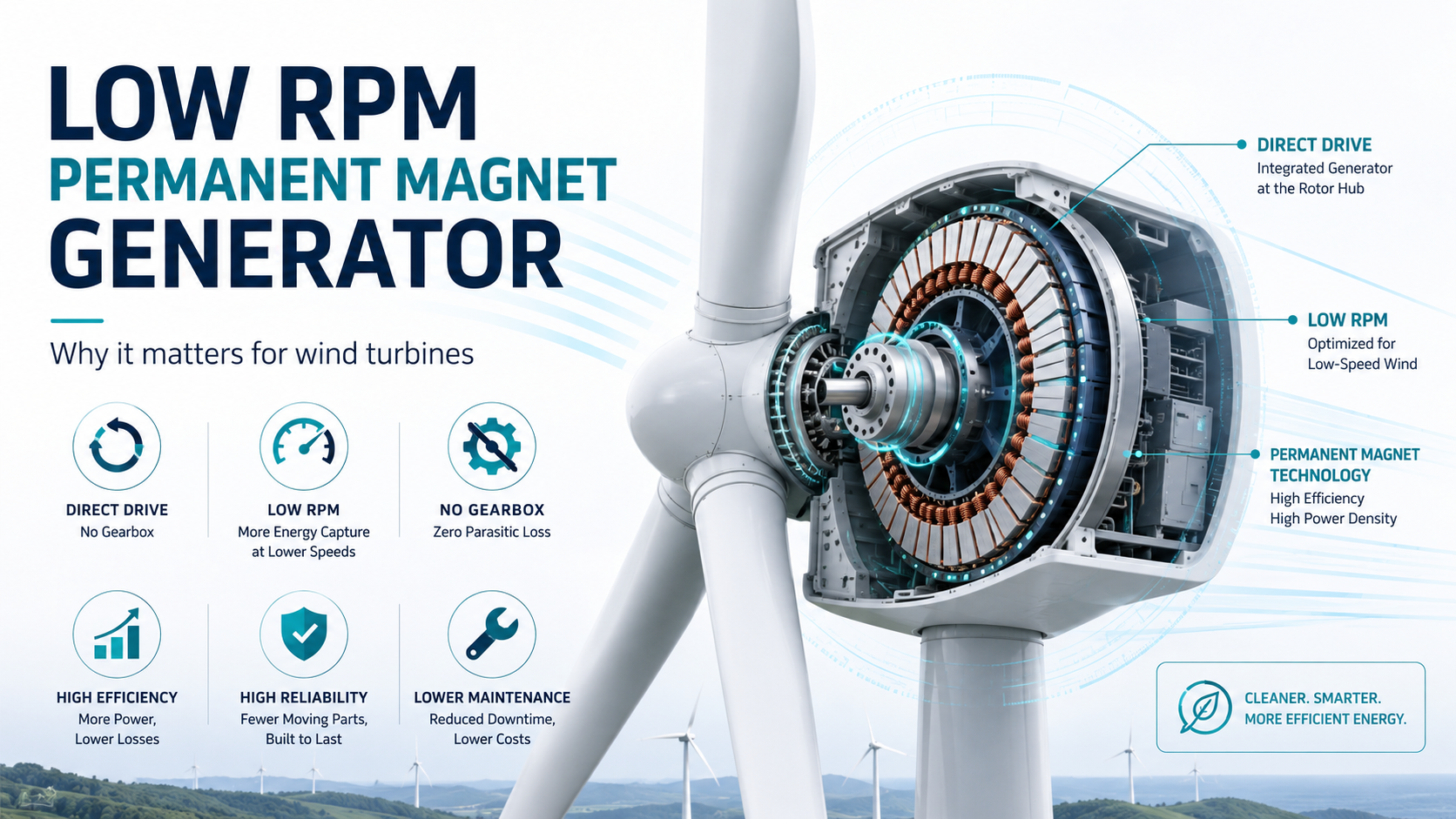
The transition from traditional gearbox-driven wind turbines to direct-drive architectures is reshaping operations and maintenance economics. Today, energy developers constantly seek reliable ways to maximize power yield while minimizing mechanical vulnerabilities. As turbine sizes scale—particularly in offshore environments where wind speeds remain stronger and more consistent—the mechanical complexities of traditional drivetrains become cost-prohibitive liability points. Heavy mechanical gearboxes create intense friction. They lead to frequent unplanned downtime and expensive offshore interventions.
For project developers and engineers, specifying a low RPM permanent magnet generator is no longer just about optimizing aerodynamic efficiency. It serves as a critical strategy for eliminating parasitic electrical losses. It drastically reduces mechanical failure rates. Furthermore, it ensures a highly viable 20-year operational lifecycle. In this comprehensive guide, you will discover why direct-drive systems consistently outpace older mechanical designs. We will explore how zero-parasitic-loss technology significantly improves low-speed energy capture. Finally, we will outline strict verification frameworks to help you evaluate supplier magnetization quality and protect your renewable energy investments.
Direct-Drive Reliability: Low RPM PMGs eliminate the need for heavy-maintenance gearboxes and slip rings, drastically reducing mechanical friction and failure points.
Zero Parasitic Loss: Unlike electromagnets that require external power for excitation, permanent magnets generate their own magnetic field, increasing the net power output fed back to the grid.
Low-Speed Efficiency: Multipole synchronous designs allow turbines to capture usable kinetic energy even at marginal wind speeds, improving overall capacity factors.
Manufacturing Quality Matters: A PMG's long-term performance relies entirely on the initial industrial magnetization process, requiring precise 3-5 Tesla pulses to achieve maximum magnetic saturation and prevent premature degradation.
Structural Synergy: The use of rare-earth magnets extends beyond the generator; magnetic mounting solutions inside the turbine tower prevent structural fatigue caused by traditional welding and drilling.
Traditional wind turbines rely heavily on mechanical gearboxes. They use them to step up low blade RPMs. Standard induction generators require these high speeds to function properly. However, gearboxes act as massive friction hubs. They generate extreme heat and constant mechanical stress. Consequently, they remain the primary cause of unplanned turbine downtime. Fixing a broken offshore gearbox requires highly specialized heavy-lift vessels. These crane mobilizations drain project budgets rapidly. Oil contamination also presents a persistent operational hazard.
A direct-drive architecture changes this dynamic completely. A low RPM permanent magnet generator connects directly to the main rotor axis. This elegant design entirely eliminates the mechanical step-up phase. By utilizing a large multipole synchronous array, the generator achieves high torque density natively. It converts slow mechanical rotations directly into grid-ready electrical frequencies. You bypass the highest-friction component entirely. This massively improves asset reliability.
Engineers must evaluate the upfront capital expenditure of rare-earth magnets accurately. You should weigh this initial cost against massive operational savings. Direct-drive architectures remove complex preventative maintenance routines. You completely eliminate gearbox lubrication schedules. You no longer need to replace worn electrical slip rings. Furthermore, you drastically reduce costly crane-mobilization events over a standard 20-year lifecycle. These cumulative savings easily justify the initial premium.
Consider these common mistakes when managing legacy drivetrains:
Ignoring microscopic metal shavings inside gearbox oil reservoirs.
Underestimating slip-ring wear rates in highly corrosive marine environments.
Failing to account for escalating heavy-lift vessel day rates during financial modeling.
Traditional electrically excited generators face a severe built-in efficiency limit. They must actively consume a portion of the turbine's generated electricity. They use this internal draw to power the rotor's magnetic field. Engineers refer to this as parasitic electrical loss. It actively lowers the net yield delivered back to the grid. During marginal wind conditions, this internal power draw becomes financially detrimental.
Neodymium (NdFeB) magnets operate under entirely different physical principles. They do not need any external electrical excitation to function. They naturally create their own stable magnetic field. This creates a highly efficient zero-parasitic-loss design framework. Consequently, every rotational degree translates strictly to grid-bound power. You stop wasting your own generated electricity. The overall net output rises noticeably.
Wind power generation follows the strict cube of wind speed. If wind speed drops slightly, available kinetic energy drops exponentially. Theoretical aerodynamic extraction limits max out around 60%. Practically, modern utility-scale turbines capture roughly 45%. A multipole synchronous generator excels under these physical constraints. It uniquely captures energy during sub-optimal periods. Traditional generators often stall or trip offline when wind speeds drop. Direct-drive permanent magnet units stay online longer. They maximize the site's overall capacity factor.
Operational Feature | Electromagnet Systems | Permanent Magnet Generators |
|---|---|---|
Excitation Source | External grid or internal parasitic power | Native Neodymium (NdFeB) magnetic field |
Net Power Yield | Reduced continuously by electrical draw | Maximized directly by zero parasitic loss |
Low-Speed Capture | Often stalls or trips offline quickly | Captures marginal kinetic energy highly efficiently |
Hardware implementation carries distinct physical risks. A generator holds only as much reliability as its internal magnets. Manufacturers must execute the initial magnetization process perfectly. Incomplete magnetic saturation guarantees rapid field degradation. Efficiency drops become immediately noticeable after grid connection. A poorly magnetized multipole array fundamentally ruins the direct-drive advantage.
Procurement teams must aggressively vet supplier QA processes. You should thoroughly inspect their factory magnetization equipment. Never assume all permanent magnets arrive fully saturated. You must demand strict documentation. Industrial quality control separates highly viable wind assets from costly liabilities.
Rare-earth magnets feature exceptionally high coercivity. They strongly resist external magnetic fields. Therefore, they demand precisely controlled capacitive discharge pulses. These industrial pulses must reach 3 to 5 Tesla safely. Only this massive energy surge unlocks their full magnetic potential. Anything less leaves the neodymium structure partially dormant. This limits torque density severely.
Manual rotor assembly invites serious performance inconsistencies. You should look for suppliers deploying heavy-duty custom fixtures. They must use advanced PLC-automated magnetizers. This technology ensures absolute uniformity across large multipole rotor arrays. Robotic handling prevents accidental chipping or misalignment.
Follow these best practices when auditing prospective suppliers:
Request historical magnetic degradation test data spanning previous installations.
Inspect the factory's capacitive discharge equipment for 3-5 Tesla capacity ratings.
Verify advanced PLC automation metrics applied to their multipole array assembly lines.
Direct-drive systems remove massive gearbox weight entirely. However, large multipole arrays remain quite heavy themselves. You must carefully evaluate your specific nacelle weight limits. Offshore and floating wind platforms handle this structural tradeoff exceptionally well. Their buoyant foundations support massive top-weight easily. Conversely, land-constrained towers often face stricter transport and lifting limitations. Engineers must balance aerodynamic gains against precise logistical constraints.
Permanent magnet technology benefits the broader facility infrastructure too. Tall wind towers house many essential internal components. Safety ladders and heavy power cables stretch up the interior walls. Traditional installation methods require drilling or welding heavy steel brackets directly to the shell. These aggressive actions induce destructive metal fatigue over time. They also invite severe rust and dangerous structural corrosion.
Industrial-strength magnetic assemblies fix this infrastructure problem beautifully. They offer highly secure, completely non-destructive mounting solutions. You instantly preserve the tower's structural integrity. Technicians snap cable brackets onto the wall without piercing the steel. Furthermore, you significantly reduce overall interior installation time. This structural synergy demonstrates how rare-earth elements improve the entire asset lifecycle. To learn more about modern wind component integration, please contact us for expert engineering guidance.
You must model your financial returns accurately. Start by analyzing site-specific wind histogram data. Weigh the increased low-wind-speed yield against upfront hardware costs. Neodymium magnets undeniably require higher initial capital. However, higher capacity factors often offset this premium within the first few years. Low RPM energy capture remains highly lucrative.
Calculate your precise maintenance labor reductions. You will completely avoid hazardous gearbox oil changes. You also eliminate frequent slip ring wear replacements. This drastically improves project economics over the long run. Offshore developers specifically benefit from reduced heavy-vessel chartering.
Hold your generator manufacturers strictly accountable. Require official OEM documentation regarding factory magnetic saturation testing. You need clear, scientifically validated degradation curves. These curves must span a minimum 20-year horizon. Proper thermal management guarantees these magnets survive decades of continuous rotation.
Evaluation Metric | Target Standard | Why It Matters |
|---|---|---|
Magnetic Saturation | 3 to 5 Tesla capacitive pulses | Ensures 20-year field stability and prevents yield drop. |
Assembly Automation | PLC-controlled robotic fixtures | Guarantees performance uniformity across large multipole arrays. |
Preventative O&M | Zero gearbox oil or slip ring changes | Reduces lifecycle labor and limits costly offshore crane interventions. |
Low RPM direct-drive technology represents the most efficient alignment of aerodynamic potential and electrical output. It effectively strips away the heavy mechanical liabilities found in older turbine models. By eliminating gearboxes, you drastically reduce friction, heat, and unplanned maintenance events. Zero-parasitic-loss designs guarantee maximum grid yield. Furthermore, robust industrial magnetization ensures your equipment performs reliably for decades.
Your next steps require precise technical diligence. Review your site-specific wind distribution data today. Audit your potential manufacturers strictly to verify robust magnetization processes meeting the 3-5 Tesla standard. Finally, request comprehensive lifecycle financial analyses. Compare standard gearbox models directly against direct-drive architectures. This evidence-based approach validates your investment and secures maximum renewable energy returns.
A: By using a large multipole synchronous generator design, PMGs achieve the necessary torque density and frequency output directly from the low rotational speed of the turbine blades. This advanced architecture entirely bypasses mechanical multiplication. You eliminate the high-friction gearbox completely, drastically improving overall mechanical reliability.
A: High-quality neodymium magnets experience negligible degradation over a standard 20-year lifespan. This holds true provided they undergo full magnetic saturation during manufacturing and operate within strict thermal limits. Proper industrial anti-corrosion coatings also play a critical role in preserving their long-term field strength.
A: PMGs do not require an initial electrical current to "wake up" the magnetic field. This zero-excitation-loss feature allows them to begin generating net positive power at much lower cut-in wind speeds. Traditional electromagnets struggle in these scenarios, often stalling entirely when wind kinetic energy drops.
