Views: 0 Author: Site Editor Publish Time: 2026-05-26 Origin: Site
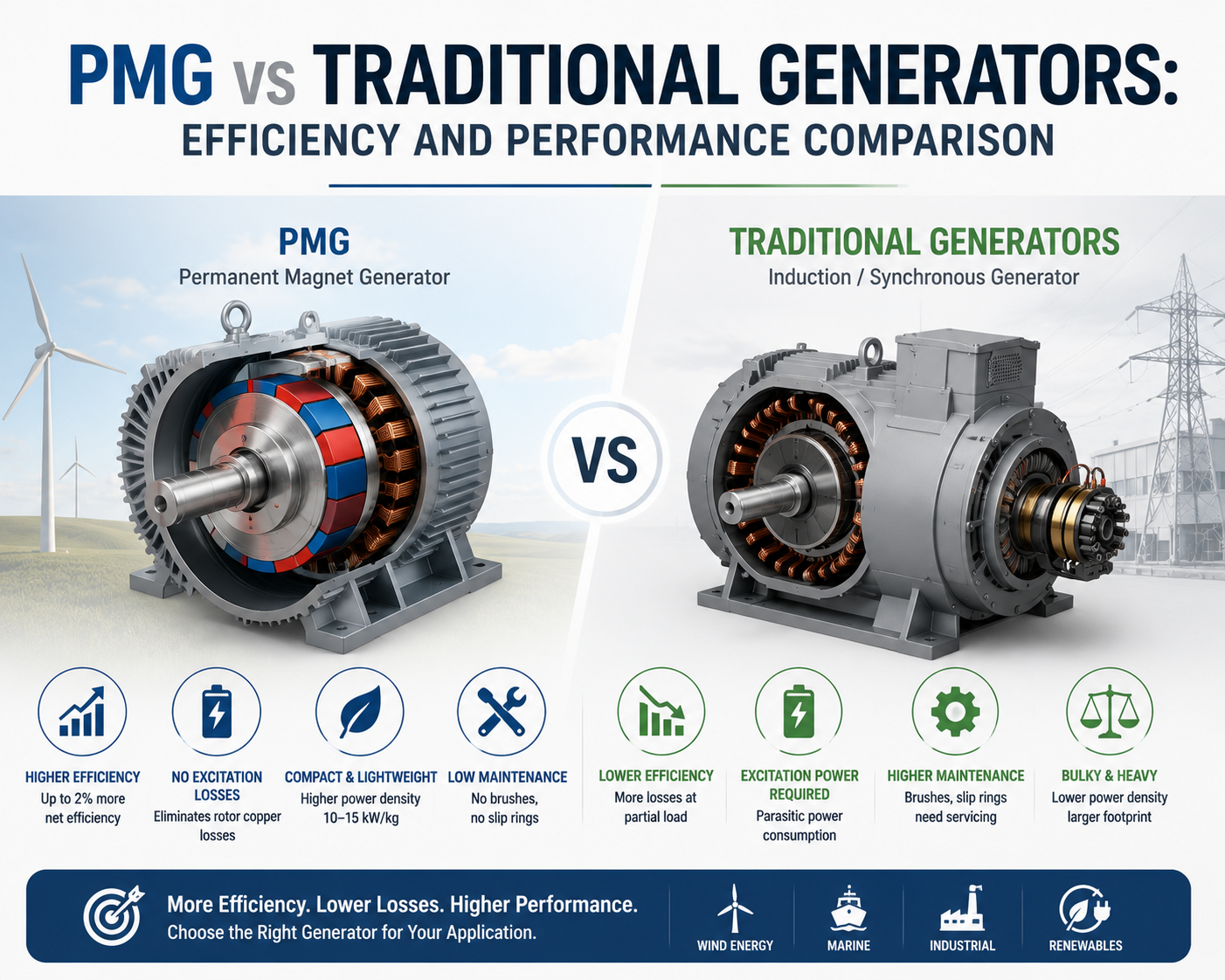
The transition to highly optimized renewable energy and industrial power systems has elevated the engineering debate between the permanent magnet generator and traditional asynchronous or synchronous alternators. Engineers constantly seek methods to maximize energy capture while minimizing mechanical complexities. We see this shift accelerating rapidly across wind energy, marine, and aerospace sectors.
Engineers and procurement teams must balance the immediate capital expenditure of rare-earth magnets against long-term operational savings. These financial returns are primarily driven by higher efficiency and reduced maintenance demands over the equipment's lifespan. Choosing the wrong topology can lead to massive budget overruns or crippling downtime.
This guide evaluates both technologies through a practical application-fit lens. We bypass marketing claims to focus entirely on hard performance metrics, thermal behaviors, and structural reliability. You will learn exactly how to match the right generator to your specific project constraints.
Efficiency Gains: A permanent magnet generator eliminates external excitation losses, yielding up to a 2% net efficiency increase and superior partial-load performance (90–94% efficiency at 40% load).
Mechanical Simplification: Eliminating brushes, slip rings, and gearboxes (via direct-drive) reduces friction-based maintenance and cuts overall system weight, achieving 10–15 kW/kg power density.
TCO Trade-offs: The high initial cost and supply-chain volatility of rare-earth materials (NdFeB, SmCo) mandate a strict ROI calculation, making PMGs highly viable for remote/offshore locations but potentially over-engineered for highly accessible, budget-sensitive terrestrial projects.
Understanding the fundamental design differences between generator types clarifies why they perform differently under load. The core distinction lies in how they create the magnetic field required to induce electricity.
Traditional alternators rely on an external power source or a separate excitation system. They magnetize the rotor by pushing continuous electrical current through copper windings. This process creates an electromagnet. Because the rotor spins, delivering this current usually requires physical connections like brushes and slip rings. Over time, these mechanical contact points experience friction, wear down, and require regular replacement.
A permanent magnet generator takes a fundamentally different path. It utilizes internally integrated permanent magnets to generate a steady, powerful magnetic field. This field interacts directly with the stator. By using permanent magnets, the design completely removes the need for an external excitation current. You eliminate the parasitic power draw required to magnetize the rotor, which immediately boosts the net electrical output.
You should acknowledge the market is not strictly binary. Advanced pure-copper classic synchronous generators are emerging as viable mid-ground alternatives. When paired with highly optimized power electronics, these modern wound-field systems can rival permanent magnet efficiencies. They offer a compelling choice for engineers looking to avoid rare-earth material dependencies while maintaining high performance.
Efficiency is the primary metric driving the adoption of permanent magnet technology. However, you must evaluate efficiency across the entire operational spectrum, not just at peak load.
Removing rotor currents provides a massive thermal and electrical advantage. In traditional systems, pushing current through rotor windings generates heat. Engineers refer to this as I²R or copper loss. Traditional large-scale generators continuously bleed power just to maintain their magnetic fields. By removing these rotor currents, copper losses drop significantly. A permanent magnet system recovers this wasted power, converting it directly into usable net system output.
Renewable energy environments rarely provide constant input power. Wind speeds fluctuate, and water flow rates change. PMGs excel in capturing maximum Annual Energy Output (AEO) in these variable conditions. Because they do not rely on a fixed grid frequency to maintain excitation, they operate highly efficiently across a broad speed range. This flexibility offers 6–12% higher energy yields compared to fixed-speed induction systems.
Generators rarely operate at 100% capacity. You must look closely at partial-load performance. Traditional induction generators suffer significant efficiency drops at lower speeds. At 40% load, their efficiency often falls to 80–85%. In stark contrast, PMGs maintain a stable 90–94% efficiency band even when operating well below peak capacity. This resilience ensures consistent energy generation during suboptimal environmental conditions.
Performance Metric | Permanent Magnet Generator | Traditional Induction/Synchronous |
|---|---|---|
Excitation Power Required | Zero (Permanent field) | High (Parasitic draw) |
Partial-Load Efficiency (40%) | 90–94% | 80–85% |
Annual Energy Output (AEO) | +6% to +12% vs Baseline | Baseline standard |
Variable Speed Operation | Excellent native support | Requires complex control systems |
Physical size and mechanical complexity heavily influence installation logistics and ongoing maintenance budgets. Here, the architectural simplicity of permanent magnets offers distinct advantages.
The structural advantage of permanent magnets is undeniable. They utilize exceptionally high-strength magnetic fields, typically featuring a 0.9 to 1.2 Tesla air gap. This intense field strength allows PMGs to achieve a power density of 10–15 kW/kg. Traditional motors generally peak around 5–7 kW/kg. For applications like wind turbine nacelles or marine propulsion, cutting the generator weight in half drastically reduces structural support requirements.
Gearboxes introduce massive mechanical liabilities. They introduce a 5–12% mechanical energy loss due to internal friction. More importantly, gearboxes remain a primary failure point in heavy industrial equipment. PMGs enable direct-drive integration. By coupling the rotor directly to the power source, you bypass the gearbox entirely. This simplified mechanical path achieves an impressive 94–98% total electrical efficiency.
Maintenance metrics shift dramatically when you remove moving parts. The absence of slip rings and brushes removes scheduled friction-wear maintenance. Historically, eliminating these physical contact points reduces lifetime machine downtime by 30–50%.
Alignment Tolerance: Ensure precise laser alignment during direct-drive installation to prevent uneven bearing wear.
Vibration Monitoring: Implement continuous vibration sensors to detect early bearing fatigue, as the generator now absorbs direct mechanical loads.
Sealing: Utilize high-grade ingress protection (IP65 or higher) since direct-drive units often face harsher environmental exposure.
Raw power generation is only part of the equation. The quality of the electrical output and the machine's ability to shed heat define its long-term viability.
Power electronics require clean voltage waveforms to operate predictably. Advanced PMG topologies, particularly specific axial-flux winding configurations, generate highly sinusoidal voltage waveforms. This precise engineering results in lower total harmonic distortion (THD). Lower THD is essential for sensitive microgrids, data centers, or medical applications where erratic power causes equipment failure.
Heat destroys electrical insulation. Because they eliminate rotor copper losses, PMGs typically operate 10–25°C cooler than identically rated wound-field alternators. This lower thermal stress yields massive dividends over time. Running cooler extends internal insulation lifespan by up to 20–30%, drastically delaying the need for costly complete rewinds.
You must choose between two primary magnetic flux directions based on your application size.
Axial-Flux PMGs: Often called "pancake" motors. They offer superior voltage regulation and exceptional power density at smaller scales. They suit space-constrained environments perfectly.
Radial-Flux PMGs: The traditional cylindrical design. They are much easier to manufacture at scale. They provide higher absolute output power, making them the standard choice for multi-megawatt industrial installations.
No engineering solution is perfect. You must objectively evaluate the risks associated with permanent magnet technology to make an informed procurement decision.
You must address the elephant in the room. The reliance on rare earth elements, specifically Neodymium (NdFeB) and Samarium-Cobalt (SmCo), makes initial procurement significantly more expensive. Furthermore, the supply chain for these metals remains highly concentrated. This concentration subjects buyers to severe geopolitical pricing volatility. A sudden spike in rare-earth prices can instantly destroy a project's budget.
Engineers face a distinct environmental paradox here. On one hand, PMGs deliver a vastly lower lifetime carbon footprint due to their incredible operational efficiency. On the other hand, the ecologically intensive mining and refining processes required for rare-earth magnet production carry severe environmental penalties. You must weigh operational carbon savings against the ecological cost of manufacturing.
Magnets can lose their power if pushed beyond their physical limits. Permanent demagnetization remains a critical operational risk. This typically occurs during extreme thermal events or severe short-circuit faults. If the internal temperature exceeds the magnet's Curie point, the magnetic field degrades permanently.
Inadequate Cooling: Relying on passive cooling in high-ambient temperature environments. Always over-engineer the active cooling loop.
Poor Fault Protection: Failing to install fast-acting inverter protection. A sustained short-circuit can induce reverse magnetic fields strong enough to demagnetize the rotor.
Technology selection should rely entirely on environmental realities and budget constraints. Use the following framework to dictate your specifications.
Certain scenarios overwhelmingly favor the adoption of permanent magnets. You should specify them in the following environments:
Offshore Wind Turbines: Dispatching maintenance crews to offshore platforms is cost-prohibitive. The high reliability and absence of brush replacements make PMGs ideal.
Remote Telecom Towers: Similar to offshore environments, remote terrestrial sites benefit from the "install and forget" nature of brushless systems.
Space-Constrained Environments: Marine vessels and aerospace applications require maximum power-to-weight ratios. The 10–15 kW/kg density solves severe weight constraints.
Variable-Speed Systems: Any application heavily reliant on fluctuating input speeds and direct-drive setups will capture more energy with a PMG.
Traditional alternators remain highly relevant. You should stick with conventional systems in the following scenarios:
Accessible Industrial Plants: If your onshore wind farm or factory has cheap, readily available maintenance crews, the premium for brushless technology may not be justified.
Strict CapEx Ceilings: Projects with rigid, inflexible upfront budget limits often cannot absorb the premium cost of rare-earth magnets.
Severe Overload Applications: Applications experiencing frequent, extreme short-term overloads favor induction stators. Wound-field systems prove exceptionally rugged under abusive transient loads without the risk of permanent demagnetization.
We encourage buyers to request comprehensive lifecycle economic models from vendors. Do not evaluate these systems on basic unit pricing alone. Explicitly factor in projected maintenance downtime, gear-loss metrics, and energy yield gains over a twenty-year horizon. If you need assistance running these complex evaluations, please contact us to consult with our engineering team.
The permanent magnet generator acts as a high-performance precision tool, not a universal silver bullet. Its superiority in electrical efficiency, weight reduction, and variable-speed energy yield is undeniable. However, this advanced performance demands strict justification against higher capital costs and supply chain risks.
Procurement decisions should pivot heavily on physical accessibility and lifecycle economics. If the operational lifespan is long and the site is remote, the upfront premium pays massive dividends. Conversely, if initial budgets are tight and maintenance access is easy, traditional wound-field alternators remain highly competitive. Evaluate your specific thermal limits, speed variability, and maintenance access before committing to a topology.
A: Not exactly. While fundamentally reversible, the sequence of power losses changes. Mechanical friction happens before electromagnetic loss in generators; the sequence is completely reversed in motors. Because friction and copper losses scale differently with speed and current, equivalent efficiency only occurs under very specific, tightly matched operating conditions.
A: Generally, no. One of their primary design advantages is the ability to operate as direct-drive systems. Their high pole counts allow them to capture energy efficiently at much lower rotational speeds. This eliminates the mechanical gearbox entirely, cutting weight and removing a major point of failure.
A: Because the magnetic field is permanent, the generator will continue producing high voltage as long as the rotor turns. It cannot be "turned off" by removing an excitation current. This requires specific power electronics, braking resistors, or mechanical braking systems to safely absorb and manage overvoltage during fault conditions.