Views: 0 Author: Site Editor Publish Time: 2026-06-09 Origin: Site
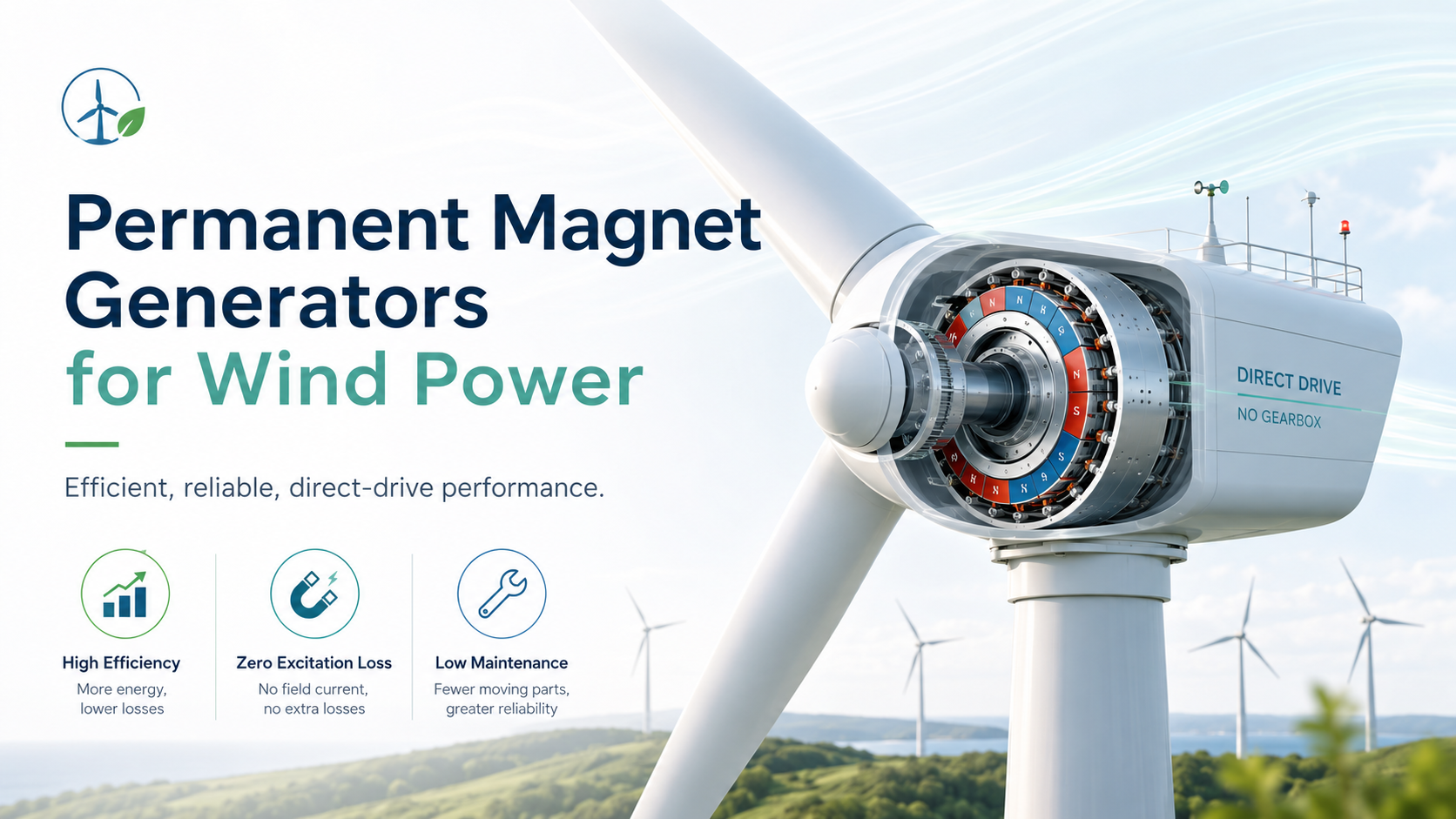
Wind farm profitability constantly battles against high operations and maintenance costs. Mechanical downtime in remote installations quickly erodes profit margins. Traditional geared induction setups rely on heavy, complex gearboxes. They fail frequently under extreme mechanical stress. You lose significant money every time a heavy-lift crane arrives for unexpected repairs.
We see a massive shift toward direct-drive architectures to solve this problem. Engineering teams want simpler, more robust powertrains. This article provides a clear, objective framework for evaluating a permanent magnet generator against traditional alternatives. We focus heavily on long-term lifecycle reliability and operational savings.
We will explore critical efficiency gains and material specification risks. You will discover exactly how to avoid common procurement mistakes. You will learn how to optimize your next utility-scale wind project for maximum net energy output.
Zero Excitation Loss: PMGs eliminate parasitic energy draw, directly increasing net energy output, especially at variable wind speeds.
O&M Reduction: By enabling direct-drive systems, PMGs remove highly vulnerable components like gearboxes, slip rings, and brushes.
Critical Specifying Factors: Long-term PMG viability relies heavily on correct material selection (NdFeB vs. SmCo), thermal rating accuracy, and optimal industrial magnetization (requiring 3-5 Tesla pulses for full saturation).
TCO over CapEx: While initial capital expenditure and supply chain dependencies for rare-earth magnets are higher, the 20-to-25-year lifecycle savings consistently validate the investment for utility-scale projects.
Traditional induction generators face a fundamental engineering problem. They require external electrical power to create their magnetic field. We call this the "parasitic load" penalty. This excitation requirement directly reduces the net usable power exported to the grid. You produce energy, but you consume a portion of it internally.
A permanent magnet generator solves this inefficiency completely. It utilizes pre-magnetized rare-earth materials to establish the magnetic field. It operates as a zero-consumption magnetic field source. You do not waste generated power on internal excitation. This directly increases your overall megawatt export.
Variable wind speed efficiency further separates the two technologies. PMGs maintain much higher efficiency curves during low wind conditions. They also perform better when wind speeds fluctuate rapidly. Asynchronous induction generators simply cannot match this low-speed performance. They lose efficiency quickly when wind drops below optimal rated speeds.
We must acknowledge an objective compromise here. Induction generators remain a viable choice for budget-sensitive onshore projects. They offer a lower initial CapEx. Maintenance crews can access them easily. However, utility-scale and offshore deployments demand better performance. The efficiency gains of a PMG drastically shorten the return on investment timeline for large turbines.
Performance Metric | Permanent Magnet Generator (PMG) | Induction Generator (IG) |
|---|---|---|
Excitation Energy Source | Inherent rare-earth magnetic field (Zero draw) | External grid or internal parasitic draw |
Low Wind Speed Efficiency | Extremely high and stable | Drops significantly off-peak |
Grid Export Potential | Maximum net output | Reduced by excitation penalty |
Ideal Application | Offshore, utility-scale, variable wind zones | Accessible onshore, budget-constrained sites |
Geared wind turbines rely on highly complex mechanical gearboxes. These gearboxes step up the slow blade rotation speed. The generator needs this high speed to function properly. However, gearboxes create a severe mechanical bottleneck in wind farms. They endure massive torque loads and harsh vibrations.
Gearboxes are high-wear components. They represent the primary source of catastrophic mechanical failures. You face massive logistical nightmares when they break. Offshore gearbox replacements require specialized heavy-lift vessels. The operational downtime ruins quarterly profitability metrics.
Direct-drive integration changes this equation entirely. PMGs function beautifully at very low rotational speeds. This unique trait allows the rotor to connect directly to the generator. You bypass the mechanical step-up process entirely.
Direct-drive PMG setups eliminate several problematic parts from the nacelle:
The High-Speed Gearbox: Removing this eliminates the heaviest maintenance burden.
Mechanical Slip Rings: You no longer deal with frequent contact wear and tear.
Carbon Brushes: You avoid the regular replacement cycles required by older architectures.
This implementation reality transforms wind farm management. Reducing these moving parts vastly extends the operational lifespan. Turbines easily reach their expected 20 to 25-year baseline. You also minimize friction-induced thermal degradation. Less mechanical friction means less destructive heat inside the nacelle housing.
Material selection defines generator success. Engineers must choose between Neodymium (NdFeB) and Samarium Cobalt (SmCo) alloys. Each material presents distinct engineering trade-offs. You must match the material strictly to the deployment environment.
Evaluating Neodymium (NdFeB):
Pros: NdFeB offers the highest maximum energy product (BHmax) available today. It is ideal for keeping the nacelle weight light. It keeps the generator dimensions physically compact. It maximizes megawatt output per kilogram of material used.
Cons: It remains highly susceptible to moisture corrosion. It also suffers irreversible thermal demagnetization if you specify the wrong temperature grade.
Evaluating Samarium Cobalt (SmCo):
Pros: SmCo is explicitly built for extreme environments. It withstands operating temperatures easily exceeding 300°C. It features high innate corrosion resistance. It does not require specialized surface coatings to survive.
Cons: It has noticeably lower magnetic strength than NdFeB. It generally comes at a much higher raw material price point.
We follow a clear decision logic in the industry. NdFeB serves as the industry standard. It covers over 90% of global wind applications. You simply need adequate cooling systems engineered into the nacelle. You also need rigorous surface protection. SmCo is reserved exclusively for highly specialized configurations. You only use it for extreme heat-intensive or highly corrosive experimental setups.
Procurement teams often miscalculate thermal ratings. They look at environmental weather instead of internal operational heat. Specifications must account for the generator’s internal coil heat. Mechanical friction also adds to this internal temperature. Selecting a standard grade for a hot environment causes irreversible thermal demagnetization. You must specify EH or UH high-temp grades for enclosed turbine nacelles.
The magnet must possess high intrinsic coercivity (Hc). High coercivity actively resists demagnetization forces. The stator produces strong opposing magnetic fields during peak load operations. Sudden grid-fault conditions also test this magnetic resistance. Low coercivity magnets will permanently lose field strength under these stresses.
Surface coating resiliency is absolutely non-negotiable. Raw rare-earth magnets corrode rapidly when exposed to humidity. Standard industrial nickel plating fails quickly in offshore wind deployments. Heavy-duty epoxy coatings are mandatory. They survive long-term marine salt-spray exposure. You must specify thick, multi-layer epoxy for ocean environments.
Manufacturing magnetization depth matters immensely. Magnets must reach a fully saturated state. Sub-tier manufacturers often lack advanced capacitive discharge technology. Proper industrial equipment must deliver 3 to 5 Tesla pulses. Weak equipment delivers under-magnetized rotors to the assembly line. This permanently caps the turbine's power generation potential. If you need to source a fully saturated, properly specified permanent magnet generator, partnering with verified experts prevents these hidden performance losses.
Specification Parameter | Common Procurement Mistake | Engineering Best Practice |
|---|---|---|
Operating Temperature | Sizing based on outside ambient weather. | Calculate internal coil heat; specify EH/UH grades. |
Intrinsic Coercivity (Hc) | Ignoring grid-fault reverse magnetic fields. | Specify high Hc to survive peak opposing loads. |
Surface Coating | Accepting standard Ni-Cu-Ni plating for offshore. | Mandate heavy-duty epoxy for marine salt-spray. |
Magnetization Pulse | Accepting unverified saturation levels. | Require vendor proof of 3-5 Tesla discharge capacity. |
Rare-earth metals require a much higher initial capital investment. We must acknowledge this CapEx reality upfront. These critical metals face concentrated global supply chain bottlenecks. Volatility remains a constant factor in procurement forecasting. Developers must secure material pricing early in the project timeline.
Buyers should require strict supply chain traceability from vendors. Environmental, Social, and Governance (ESG) compliance is critical today. ESG frameworks demand environmentally safe mining operations. Labor practices must also meet strict global standards. You cannot risk your brand reputation on opaque mineral sourcing.
End-of-life planning is rapidly becoming a project priority. Current recycling infrastructure for multi-element wind magnets remains nascent. The alloys are difficult to separate efficiently. However, procurement teams should factor in emerging decommissioning strategies. We expect material recovery technologies to improve significantly by 2030. This lowers the long-term lifecycle footprint. It helps create a necessary circular economy for critical energy transition metals.
Permanent magnet generators fundamentally shift wind energy economics. They move projects from CapEx-focused models to O&M-optimized realities. The engineering benefits heavily outweigh the initial material costs. Removing the gearbox eliminates the most expensive mechanical failures.
Project developers should take the following actionable next steps:
Default to direct-drive PMG architectures when sizing multi-megawatt or offshore turbines.
Vet your manufacturing vendors strictly on their capacitive discharge magnetization capabilities.
Verify thermal grade accuracy against internal nacelle temperatures before finalizing any purchase order.
Demand marine-grade epoxy protective coatings to prevent rapid corrosion in offshore deployments.
A: No. Unlike induction generators, PMGs rely on their inherent magnetic field, allowing them to generate power immediately as the rotor turns without drawing from the grid.
A: When correctly specified for the internal operating temperature and protected from corrosion, industrial-grade permanent magnets will maintain functional magnetic saturation for the full 20 to 25-year lifecycle of the turbine.
A: Offshore environments incur massive logistical costs for maintenance. The PMG's direct-drive design removes the high-failure gearbox and slip rings, dramatically reducing the need for costly offshore service interventions.