The 50kW Electronically Controlled Wind Turbine sets a new standard for medium-scale renewable energy generation, leveraging advanced electronic management systems to achieve exceptional wind energy utilization rates.
| Quantity: | |
|---|---|
| Start-up wind speed | 2m/s | Working wind speed | 2-20m/s |
| Rotor diameter | 15.5m | Shell material | Stainless Steel |
| Rated RPM | 80r/m | Weight | 2300-2500kg |
| Generator type | 3-phase AC PMG | Speed regulation & protection | Electromagnetic brake Mechanical brake Yawing |
| Rated voltage | AC 380V | Peak power | 55kw |
This high-performance turbine is engineered for commercial and industrial applications where maximizing energy harvest directly translates to improved return on investment. With a remarkable wind energy utilization rate of 45%, this turbine outperforms many competitors in its class, delivering annual energy production of up to 120,000 kWh in optimal wind conditions. The core of its performance lies in the sophisticated electronic control system that continuously optimizes operation based on real-time wind conditions, ensuring maximum energy capture across varying wind speeds from 2m/s to 20m/s. Designed for reliability and scalability, this turbine represents a smart investment for businesses and energy developers seeking to maximize renewable energy production and minimize operational costs.
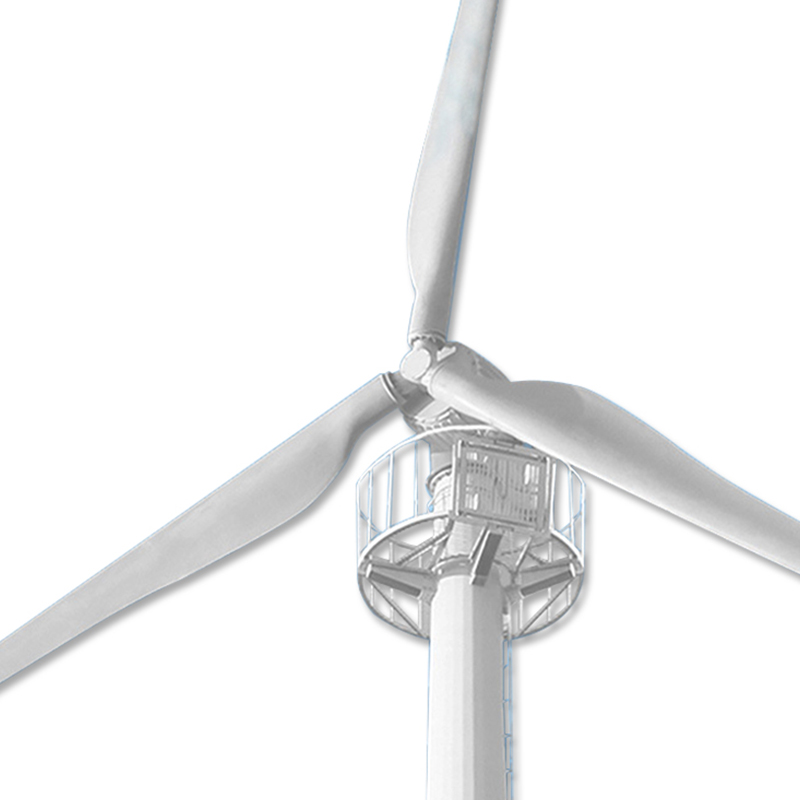
At the heart of the turbine is a state-of-the-art electronic management system that adjusts blade pitch and generator load 50 times per second, optimizing energy capture in real-time. This precision control enables the turbine to maintain a 45% wind energy utilization rate across its entire operating range, significantly higher than mechanical control systems .
The turbine features dual MPPT (Maximum Power Point Tracking) controllers with 99.9% tracking accuracy, ensuring optimal power output even as wind speeds fluctuate. The system automatically adjusts to changing conditions, maintaining stable output from cut-in speed (2m/s) through rated speed (20m/s) to ensure consistent energy production.
Equipped with advanced power electronics that provide LVRT (Low Voltage Ride Through) capability, the turbine maintains grid connection during voltage fluctuations, supporting network stability as required by modern utility codes . It offers flexible output options (400V/690V AC three-phase) for seamless integration with various electrical systems.
The integrated SCADA-compatible monitoring platform provides real-time performance data, including energy production, wind speed, and system health metrics. Advanced diagnostics alert operators to potential issues before they affect performance, while remote access capabilities enable off-site monitoring and adjustments.
Factories, manufacturing plants, and industrial parks utilize the 55kW turbine to offset significant portions of their electricity consumption, reducing energy costs and hedging against utility price volatility while meeting sustainability goals.
Energy developers deploy multiple turbines in wind farms configurations to create medium-scale renewable energy projects, leveraging the high utilization rate to maximize project profitability and meet renewable portfolio standards.
Large-scale farming operations and agricultural cooperatives use the turbine to power irrigation systems, grain drying equipment, and processing facilities, achieving energy independence for critical operations.
Off-grid mining sites and resource extraction facilities utilize the turbine as part of hybrid energy systems, reducing reliance on diesel generators, lowering fuel transportation costs, and minimizing environmental impact in sensitive areas.
The turbine's advanced electronic control system continuously adjusts blade angle and generator load 50 times per second, optimizing energy capture in real-time. This precision control, combined with aerodynamically optimized blades and dual MPPT tracking, enables a 45% utilization rate, significantly higher than the 30-35% typical for mechanically controlled turbines in this class.
Unlike mechanical systems with fixed settings, our electronic controller uses sensor data and predictive algorithms to optimize operation for current wind conditions. It can rapidly respond to gusts, maintain optimal rotor speed, and reduce energy loss during wind speed fluctuations, particularly improving performance in variable wind environments.
The electronic control system features solid-state components with no moving parts, requiring minimal maintenance. We recommend annual software updates and quarterly diagnostic checks, which can be performed remotely. The system includes self-monitoring capabilities that alert operators to potential issues before they affect performance.
Yes, the turbines are designed for parallel operation with advanced synchronization capabilities. Multiple units can be connected in wind farm configurations with a central management system that optimizes overall energy production, balances loads, and provides comprehensive performance reporting for the entire installation.