Views: 0 Author: Site Editor Publish Time: 2026-08-10 Origin: Site

A wind project’s commercial viability relies entirely on foundation integrity. Foundation failures lead to catastrophic downtime, highly complex structural retrofits, or total asset loss. Designing for extreme dynamic loads, variable geotechnical realities, and strict compliance mandates leaves zero margin for error. Procurement and engineering teams face immense pressure. They must strictly adhere to complex engineering frameworks like the IEC 61400 series.
We face a significant challenge in balancing rapid project deployment against structural permanence. Suboptimal site evaluations routinely compromise long-term turbine performance. We provide a definitive evaluation framework for developers and engineering procurement teams. You can use this guide to assess site data, structural hardware, and contractor capabilities before finalizing any foundation designs. This checklist helps you eliminate costly blind spots. It empowers your team to secure a robust, compliant, and highly durable installation.
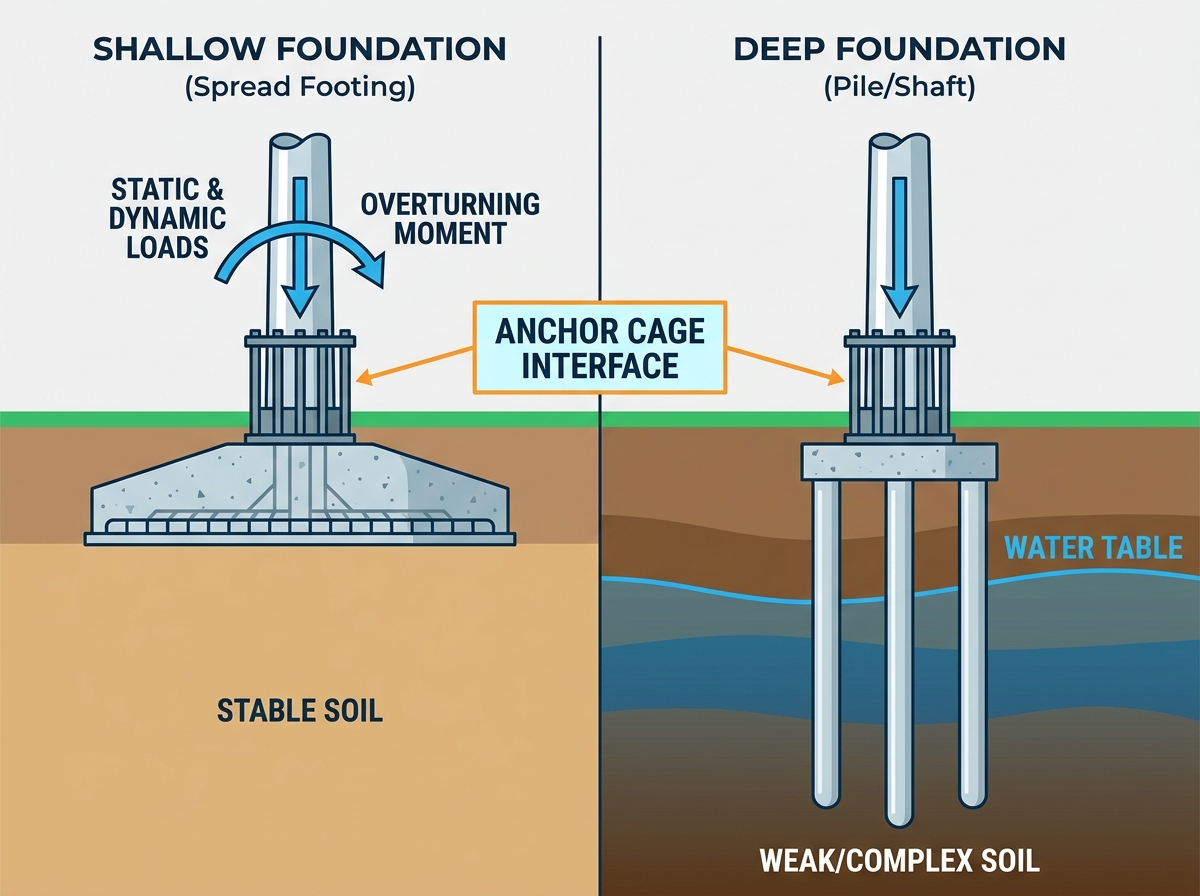
Geotechnical data dictates the model: Shallow gravity foundations versus deep pile foundations must be evaluated strictly against localized soil bearing capacity and water table data.
Anchor bolt integrity is the primary failure vector: Suboptimal tensioning or material fatigue in the anchor cage is the leading cause of structural compromise.
Dynamic loads require conservative modeling: Evaluation must account for not just static dead weight, but aerodynamic overturning moments and continuous operational vibration.
Implementation QA is non-negotiable: Even perfect designs fail without stringent oversight on concrete curing, grout application, and post-installation tension testing.
Engineering missteps during the foundation design phase carry immense financial consequences. When a foundation settles unevenly or structural grout degrades, the resulting damage compromises the entire turbine. Operators often face severe operational restrictions. In extreme cases, complete catastrophic collapse occurs. You must weigh the cost disparity between upfront quality assurance and post-construction remediation. Epoxy injections, micro-piling, and retroactive structural reinforcements cost exponentially more than conducting rigorous initial site surveys.
The structural interface acts as the central nervous system of the installation. The critical connection between the wind turbine tower pole and the concrete base dictates the lifecycle of the entire unit. If this connection degrades, harmonic vibrations amplify. These vibrations send destructive fatigue cycles directly up into the nacelle and gearbox.
Evaluating a foundation requires clearly defined success criteria. We look for three non-negotiable outcomes when reviewing initial engineering reports:
Design Life Assurance: The foundation must guarantee a 20-to-30-year operational lifespan without requiring major structural overhauls.
Strict Settlement Tolerances: The base must maintain zero differential settlement beyond the tight operational limits specified by the turbine manufacturer.
Code Compliance: The design must offer verifiable adherence to local civil engineering codes and international standards.
Site investigations form the bedrock of any successful wind energy project. You cannot rely on regional soil averages. Engineers must drill site-specific boreholes at every planned turbine location. Required data includes soil stratification, shear strength, bearing capacity, and seismic activity profiles. We use tools like Cone Penetration Testing (CPT) to gather precise sub-surface metrics.
You must evaluate foundation categories strictly against this empirical soil data. Different soil types demand distinct engineering approaches. Selecting the wrong foundation type drastically increases project risk.
Table: Foundation Types and Soil Data Comparison
Foundation Category | Soil Requirement | CAPEX Impact | Primary Use Case |
|---|---|---|---|
Shallow Foundations (Spread Footings) | High-density, stable soil or bedrock. | Most cost-effective. Low material volume. | Standard onshore sites with excellent bearing capacity. |
Deep Foundations (Piles/Drilled Shafts) | Weak soils, deep peat, or high water tables. | Significantly increases project capital expenditure. | Coastal sites, reclaimed land, or highly stratified terrain. |
Implementation risks amplify when geotechnical reports miss long-term environmental factors. Failure to account for long-term groundwater table fluctuations often leads to disaster. High water levels reduce the effective stress of the soil. During a seismic event, this triggers soil liquefaction. Liquefaction causes the soil to behave like a liquid, instantly degrading foundation support and tilting the turbine.
The anchor cage serves as the critical transition point between the flexible steel tower and the rigid concrete foundation. Evaluating the hardware requires strict attention to material specifications. Engineers must verify the yield strength requirements for wind turbine foundation anchor bolts. These components typically follow ISO 898-1 standards for high-strength steel. Inferior steel alloys fail rapidly under dynamic wind loads.
We must closely examine the design and load transfer mechanics. The anchor cage design distributes extreme tensile and compressive forces deep into the concrete matrix. When the wind pushes the turbine backwards, the front bolts experience massive tension. Simultaneously, the rear bolts face intense compression. An optimally spaced embedment ring prevents the concrete from cracking under this seesaw effect.
Fatigue and failure mitigation demand proactive engineering. You must thoroughly assess manufacturer warranties before procurement. Look for robust corrosion protection, such as hot-dip galvanization meeting precise ISO standards. Furthermore, specify fatigue-resistant thread designs. Rolled threads generally offer higher fatigue resistance compared to cut threads.
Post-installation considerations matter just as much as initial design. You must evaluate the feasibility of future maintenance protocols.
Bolt Tensioning: Can maintenance crews easily access the bolts with hydraulic tensioning tools?
Non-Destructive Testing (NDT): Is there enough clearance to perform phased array ultrasonic testing on the bolt shafts?
Replacement Access: Does the design allow for selective bolt replacement if severe localized corrosion occurs?
Wind turbines endure a chaotic mix of physical forces. Ensuring the proposed wind turbine tower foundation design adequately calculates three core forces is paramount for safety. Your engineering models must incorporate overlapping load dimensions to reflect real-world operation.
Chart: Engineering Load Model Assessment Matrix
Load Category | Primary Sources | Engineering Impact |
|---|---|---|
Static Loads | The physical dead weight of the nacelle, rotor, and tower. | Dictates basic concrete volume and minimum soil bearing pressure. |
Dynamic Operational Loads | Harmonic vibrations and mechanical resonance from spinning blades and gearbox. | Induces long-term fatigue in anchor bolts and grout interfaces. |
Extreme Environmental Loads | Maximum aerodynamic overturning moments during storms, ice loads, and seismic stress. | Requires massive overturning resistance and heavy rebar reinforcement. |
Skeptical checkpoints are necessary during the design review phase. You must verify load assumptions actively. Never accept generalized industry averages for wind classes. Ensure all mathematical models match the specific turbine manufacturer’s (OEM) data sheets. A foundation designed for a generic 2MW turbine will fail if the actual installed turbine features a slightly larger rotor diameter. Verify yaw misalignment forces and asymmetric ice accumulation models to ensure a truly conservative design.
Even a perfectly modeled foundation will fail if civil execution falls short. Evaluating contractor expertise is a critical procurement step. You must review their past performance on similar MW-class turbines. Verify their familiarization with mass concrete thermal control. Check their historical adherence to exceptionally tight construction tolerances.
We monitor several critical Quality Assurance (QA) checkpoints during construction:
Rebar and Anchor Cage Placement: Surveyors must verify the exact leveling and orientation of the bolt cage prior to the concrete pour. A misalignment of mere millimeters prevents the tower flanges from mating properly.
Concrete Curing Protocols: Massive gravity foundations generate immense heat of hydration during curing. Contractors must manage this heat using thermocouple monitoring to prevent catastrophic thermal cracking. Peak internal temperatures must remain strictly controlled.
Grout Application: The tower-to-foundation interface requires specialized high-strength, fatigue-resistant grout. Inspectors must evaluate the grout mixing, application temperature, and void-free curing processes.
Your next-step actions should focus on procurement rigor. Structure your Requests for Proposals (RFPs) to demand comprehensive details. Require detailed Quality Control Plans (QCPs) from all bidding contractors. Furthermore, mandate independent third-party testing for concrete compressive strength and steel reinforcement quality. Do not allow the general contractor to self-certify critical material milestones.
A reliable wind turbine foundation is the product of conservative load modeling, exact geotechnical matching, and flawless execution of the anchor bolt assembly. Skipping steps in soil evaluation or accepting cheap hardware creates an unacceptable risk profile for the entire asset lifecycle.
Utilize this checklist to audit preliminary engineering reports aggressively. Challenge vendor assumptions regarding wind loads and water table dynamics. Finally, finalize shortlists for civil contractors based purely on verifiable track records in mass concrete quality control.
A: Typically engineered for 20 to 30 years, aligning with the operational life of the turbine, provided routine maintenance and tension checks are performed.
A: It is highly complex and costly. Most designs rely on redundancy and post-tensioning. Total replacement often requires specialized coring and retrofitting techniques.
A: Tolerances are extremely tight (often less than 3-5 mm/m of tilt) to prevent catastrophic alterations to the dynamic load distribution and overturning moments. Specifics depend on the turbine OEM.